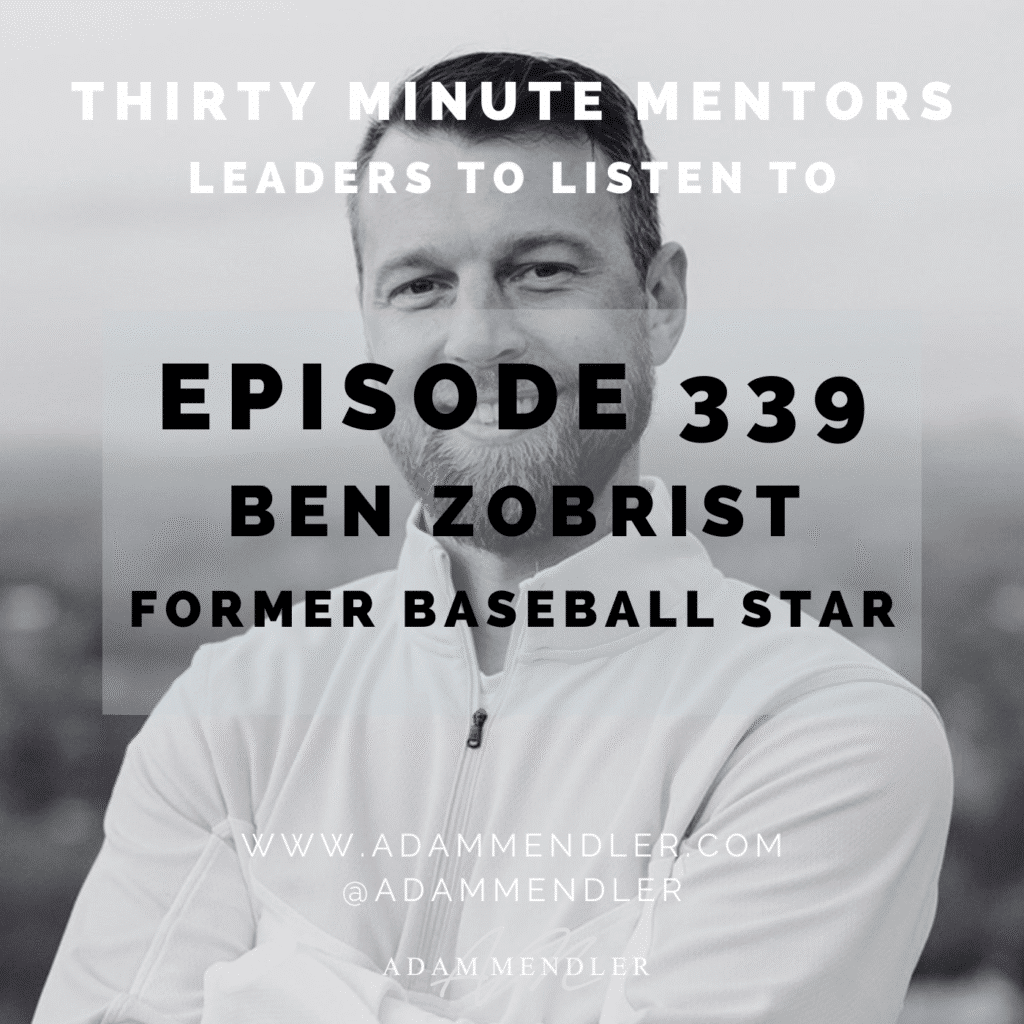
Ben Zobrist is a three-time MLB All-Star, a two-time World Series champion, and the 2016 World Series MVP, known as one of baseball’s pioneering “super utility” players for his ability to excel at nearly every position on the field. Ben joins Adam to share his journey and his best lessons and advice. Ben and Adam discuss a wide range of topics: habits for success, versatility, developing mental toughness and a winning mindset, leadership, coaching, culture, performing under pressure, and much more.
Join Adam and the best network of mentors – Fortune 500 CEOs, founders of household name companies, Hall of Fame and Olympic gold medal-winning athletes, political and military leaders – for intimate half-hour conversations each week.
Thirty Minute Mentors is available wherever you listen to podcasts. If you enjoy the episode, visit your favorite podcasting app and subscribe, rate, and leave a review, and spread the word by sharing on your social media channels and sharing directly with your friends and colleagues.
Read the full transcript of Adam’s conversation with Ben Zobrist.
Episode Summary
Ben Zobrist, a three-time All-Star and the 2016 World Series MVP, had no scholarship offers when he graduated from high school in Eureka, Illinois, and says his focus at the time was on following God, not on baseball. His high school coach, Bob Gold, called after the season and suggested a scout day near Peoria that cost $50. Ben went, and a coach from Olivet Nazarene University, an NAIA school near Chicago, called about a week later with a full ride. Ben calls what Coach Gold gave him borrowed belief. The coach had earned his trust over four years, and Ben says he did not want to let him down if he turned out to be right.
From there, Ben built his game around practicing at the intensity of a real one. He argues that raising your level only when the lights are brightest does not prepare you for the pressure of a big-game situation, and he says the nervousness of games rarely bothered him because of how he practiced. He also credits an ability to stay present, forgetting what happened earlier in the game or the day, and a habit of taking instruction from different coaches that made it easier when a coach later asked him to change positions on a major league field.
Ben’s account of the Tampa Bay Rays’ worst-to-first turnaround from 2007 to 2008 starts with leadership. He says a culture change has to begin at the top, and the 2008 team added players with a winning mindset, including Evan Longoria, whom the team had drafted in 2006, under manager Joe Maddon, with Andrew Friedman running baseball operations. The team dropped “Devil” from its name and became the Tampa Bay Rays, with a new sunburst logo the fan base embraced, and the team built a scrappy, fun identity with barely any rules and found some fight against the Yankees and Red Sox, including a brawl in spring training. Ben says Joe was good at taking pressure off players, and he trusted Joe enough to bat right-handed against the Yankees’ Mike Mussina, something he says he had not done against a right-handed pitcher in five or six years. He got a hit.
Ben also describes how pressure feels bigger as the moment gets bigger, even though the job stays the same, much like speaking to 15 people versus 1,500. He says what a person controls is the energy they bring into a situation, and that the stats and success will not matter in 50 years, but the energy will, because it carries into family life and the next role.
What You’ll Learn
- Look at the odds, not the slump: Joe Maddon’s counterintuitive logic was that a hitter who is 0 for 12 is more likely to get a hit now than he was yesterday, so Maddon was more likely to play him.
- A little fear is the price of reaching flow, Ben says, citing author Steven Kotler, and he tells himself that a big game means something great can happen.
- Fall in love with the process: in the batting cage, Ben worked like an inventor in a lab, tinkering daily with what his body needed to get his swing right, and says that process was what he loved.
- Limiting comforts like snacks and screens builds the mental toughness his father, a military man before he became a pastor, taught him, and Ben used weekend nights in college to improve.
- Great leaders take all the blame and none of the credit, Ben says, and they regulate their own emotions before they can read and regulate the feel of a clubhouse.
- Another word for confidence is faith, Ben says, and he places it in his process and who he is, not the result, so a bad day does not shake it.
About Ben Zobrist
Ben Zobrist is a former Major League Baseball player, a three-time All-Star, a two-time World Series champion, and a World Series MVP. He was one of baseball’s first super utility players, playing second base, shortstop, and the outfield while also drawing walks, stealing bases, and hitting for power and average. Ben grew up in Eureka, Illinois, where his father was a pastor, played college baseball at Olivet Nazarene University and Dallas Baptist University, and was a sixth-round pick of the Houston Astros in 2004. He played for the Tampa Bay Rays under manager Joe Maddon. Ben is the author of Prepare for the Pressure and today works through a nonprofit and as a speaker.
Related Episodes
- Episode 144: MLB Manager Joe Maddon
For more on building a winning culture, Joe, Ben’s manager with the Rays, discusses leading people and teams and developing a winning mindset. - Episode 275: MLB Manager Clint Hurdle
For more on how a manager builds trust, Clint discusses coaching and managing people and building winning cultures over 17 years as a major league manager. - Episode 262: Former Baseball Star Jake Peavy
For more on performing under pressure, Jake, a Cy Young Award winner and two-time World Series champion, discusses performing at an elite level. - Episode 193: Former Baseball Star Bernie Williams
For more on teamwork and leadership on championship teams, Bernie, a four-time World Series champion with the Yankees, discusses teamwork, leadership, and attaining greatness. - Episode 304: NFL Hall of Fame Coach Dick Vermeil
For more on motivation and culture, Dick discusses leadership, coaching, and performing under pressure, including leading the Rams to a Super Bowl championship.