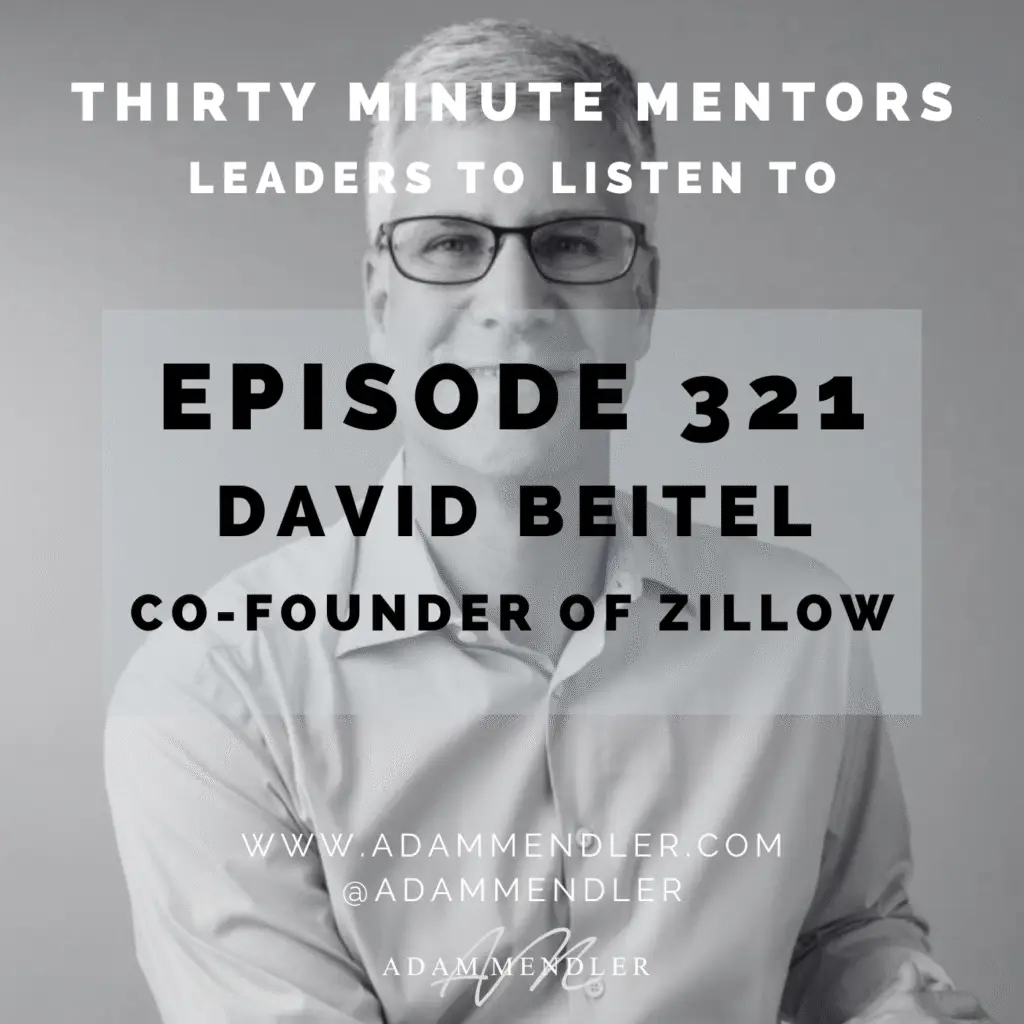
David Beitel is the Chief Technology Officer of Zillow and a member of its original founding team. David was previously the CTO and one of the earliest team members of Expedia. David joins Adam to share his journey and his best lessons learned along the way. David and Adam discuss a wide range of topics: leadership, leading remotely, how leaders can leverage AI, how technical contributors can develop soft skills and grow as leaders, career success, product development, and more.
Join Adam and the best network of mentors – Fortune 500 CEOs, founders of household name companies, Hall of Fame and Olympic gold medal-winning athletes, political and military leaders – for intimate half-hour conversations each week.
Thirty Minute Mentors is available wherever you listen to podcasts. If you enjoy the episode, visit your favorite podcasting app and subscribe, rate, and leave a review, and spread the word by sharing on your social media channels and sharing directly with your friends and colleagues.
Read the full transcript of Adam’s conversation with David Beitel.
Episode Summary
David Beitel is the CTO of Zillow, where he was part of the founding team, and was previously the CTO and one of the earliest team members of Expedia. He tells Adam how a kid from Conroe, Texas, who wrote a Christmas card database for his mother, helped build technology that changed the way people travel and the way people buy, sell, rent, and finance homes.
David describes learning to program in high school and the instant gratification of building something people could use. He started in electrical engineering at Cornell, shocked himself twice in the lab, and switched to computer science. Looking back at what set him apart, he credits hard work, patience, being a good teammate, and mentors who championed him, including a mentor he describes as Microsoft’s 80th employee, who later reported to him. He also recalls his grandfather, a retired Sears executive, telling him that technology may be what excites you, but the people make the impact.
David explains how Zillow leads in a mostly remote environment, where everyone has a square on the screen and documentation and asynchronous communication give quieter voices a way to share their best ideas. He describes leading teams through what he calls the jungle, with curiosity, self-criticism, and accountability, and rewarding risks, and even failures, while admitting your own mistakes. He also shares Zillow’s annual Hack Week, which he says brings more than 1,000 people together in Seattle and produced early ideas behind Zillow’s lending business.
On building great products, David says to focus on the customer while looking further down the road than customers can see, noting that the old joke is that people who ride horses ask for a faster horse. He points to Zillow being, as he recalls, one of the first iPhone apps, and to Zillow becoming the first real estate app on ChatGPT, which he says OpenAI gave Zillow six weeks to build. On AI, he says Zillow’s Zestimate was built almost 20 years ago, and he challenges every department head to build an AI strategy, experiment quickly, and pair small wins with long-term bets.
David closes with advice for technical professionals on developing soft skills, including that leadership does not mean management, that employees can publish their strengths and working styles internally, and that situational leadership matters. His message to listeners is to be curious, take risks, and just start.
What You’ll Learn
- Remember that people, not technology, make the impact: David’s grandfather, a retired Sears executive, told him that technology may excite you, but it is people who apply it to solve problems.
- Give people dedicated time to explore ideas off the roadmap: Zillow’s annual Hack Week brings, David says, more than 1,000 people together in Seattle, and ideas from it became part of the core of Zillow’s lending business.
- Use documentation and asynchronous communication to give quieter people a voice: David says leading a mostly remote team can create an even playing field.
- Be willing to say yes to long shots: when, as David recalls, OpenAI gave Zillow six weeks to build an app for ChatGPT, David’s team committed before knowing how it would work, and Zillow became the first real estate app on ChatGPT.
- Challenge every department to build an AI strategy: David says Zillow is asking every department head, from finance and legal to sales, to build one.
- Be introspective about your strengths: David encourages people to understand their strengths, their working style, what drives them, and where they struggle.
About David Beitel
David Beitel is the CTO of Zillow, the technology platform that changed the way people buy, sell, rent, and finance homes. He grew up in Conroe, Texas, studied computer science at Cornell, and began his career at Microsoft, where he was a member of the original Expedia team. He later served as Expedia’s CTO before joining the founding team of Zillow in 2005. He has spent more than 20 years at Zillow, where the Zestimate was an early example of the company’s use of AI.
Related Episodes
- Episode 1: Kayak Co-Founder Keith Melnick
For more on entrepreneurship and leadership, Keith discusses his path from engineering student to co-founding Kayak, along with his lessons on hiring and raising capital. - Episode 189: Former Snowflake CEO Bob Muglia
For more on what leaders should understand about AI and data, Bob discusses leading Snowflake, running a division of Microsoft, and lessons from Bill Gates and Steve Ballmer. - Episode 274: Thomson Reuters CEO Steve Hasker
For more on AI and data-driven businesses, Steve discusses leading Thomson Reuters through change and transformation, AI, and customer centricity. - Episode 186: Pure Storage Co-Founder John Colgrove
For more on technical founders building companies, John discusses co-founding Pure Storage and his lessons on ideation, vision, growth and scale, and culture. - Episode 176: AOL Co-Founder Steve Case
For more on the early internet, Steve discusses co-founding and leading AOL and his lessons on entrepreneurship, building winning teams, and investing.