
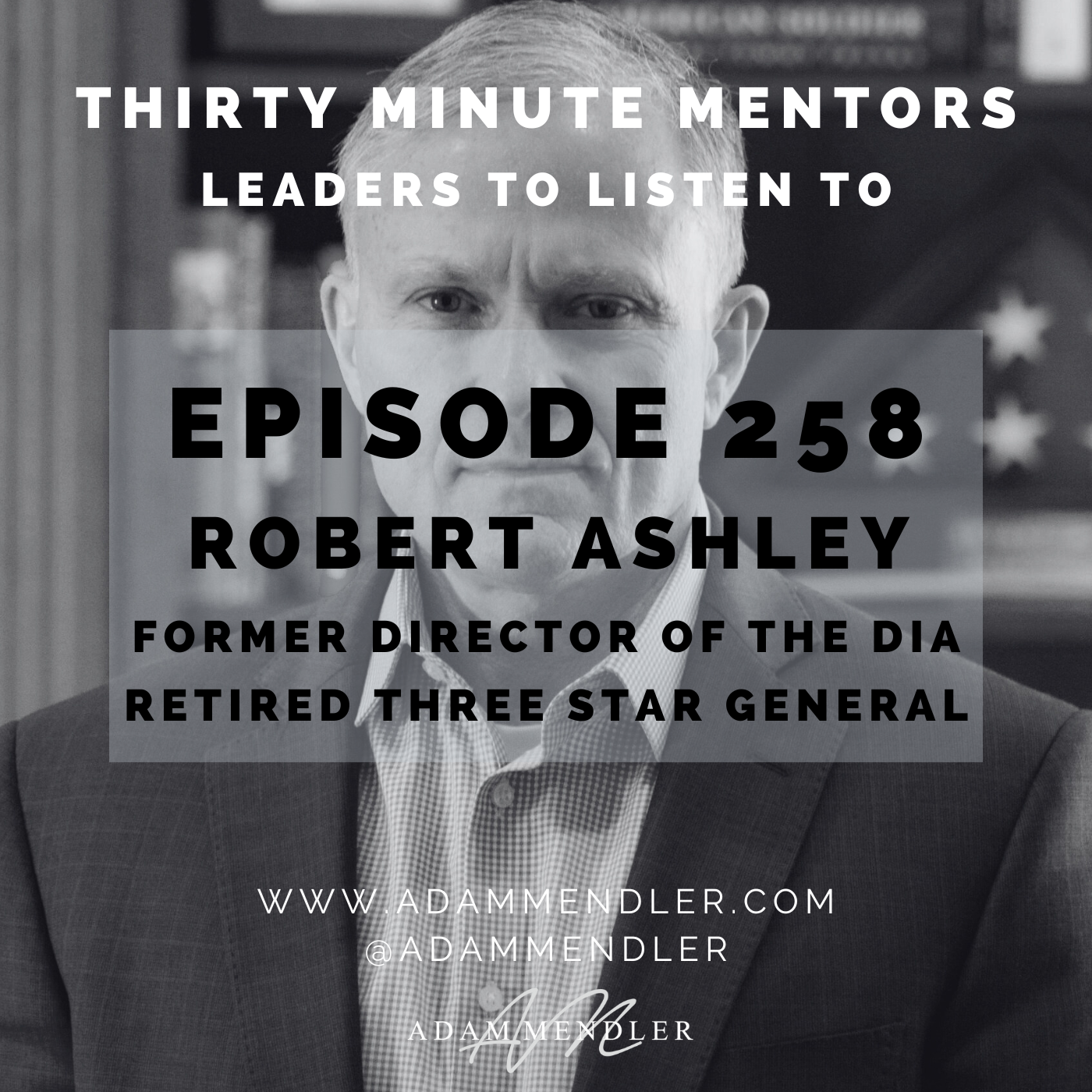
Episode 258: Lieutenant General Robert Ashley Jr.
Lieutenant General Robert Ashley was the senior advisor to the Secretary of the Army and Chief of Staff of the Army for all aspects of intelligence, counterintelligence, and security before becoming the Director of the Defense Intelligence Agency (DIA). LTG Ashley joins Adam to share his journey and his best lessons and advice. LTG Ashley and Adam discuss a wide range of topics: leadership, career success, relationship building, trust, motivation and persuasion, introversion, and much more.
Join Adam and the best network of mentors – Fortune 500 CEOs, founders of household name companies, Hall of Fame and Olympic gold medal-winning athletes, political and military leaders – for intimate half-hour conversations each week. Thirty Minute Mentors is available wherever you listen to podcasts. If you enjoy the episode, visit your favorite podcasting app and subscribe, rate, and leave a review, and spread the word by sharing on your social media channels and sharing directly with your friends and colleagues.




Read the full transcript of Adam’s conversation with Lieutenant General Robert Ashley Jr.
Episode Summary
Lieutenant General Robert Ashley Jr. is a retired Army military intelligence officer who served as the Army’s deputy chief of staff, G-2, and then as the 21st Director of the Defense Intelligence Agency. He tells Adam how the son of North Carolina parents with a 10th grade education rose from second lieutenant to three-star general, and shares how he built trust with the people he led.
General Ashley credits his parents with his work ethic, and his older brother, Steve, six years his senior, with the inspiration to pursue an education. He says Steve worked jobs as a janitor to put himself through school, earned an aerospace engineering degree, and became an Air Force pilot, and that he thinks one of his brother’s biggest fears was that he would settle for staying in their hometown. A James Bond fan as a kid, General Ashley says his actual path into the Army began on the Appalachian State campus, where a chance meeting with Benny Duncan, a high school classmate in uniform, led him to ROTC and to active duty in 1984.
He says he rose one day at a time, with a little luck, a lot of help from mentors and coaches, and a focus on doing his job the best he could every day. Inspired by Simon Sinek’s message that why you do something is what inspires people, he describes his why as a bullseye, with his kids, grandsons, and spouse at the center and the hopes and dreams of 330 million Americans on the outer ring. The skills that mattered most, he says, were not necessarily technical but human: listening, communicating, and empathy.
Building relationships, he says, comes down to trust and transparency. As DIA director, he wrote a note to everyone at the agency every Sunday about what he was working on and what concerned him, sometimes adding a word on Appalachian State or a Pink Floyd song. The notes became known as the Sunday missive, and he recalls Secretary of Defense Jim Mattis, for whom he had worked at Central Command, asking him about it. A self-described introvert who channels his inner extrovert in public, he tells of a mid-grade officer who got to know him as Bob at the gym and later called him Bob in front of a town hall audience, which he told the audience he was okay with. To set the tone for DIA’s culture, he wrote a Director’s Intent: strive to be great teammates, listen first, be accountable for your own behavior, challenge the status quo respectfully, move at the speed of war, complete the run together, and value people.
Trust, he says, cannot be surged; it is built over time and can be lost in a second. To motivate people, help them understand the importance of the task and their role in it, and, as futurist Peter Singer told him, make sure they see themselves in the story. His own education as a leader, he says, rests on three legs: personal experience, observing other leaders, and reading biographies. He shares Lou Holtz’s philosophy, do your best, do what’s right, and treat others as you would have them treat you, and he argues that leadership is a decision, not a position.
General Ashley sees leadership as a lifelong journey. He recalls Barb Fast, an Army one-star, telling him and other lieutenant colonels preparing for battalion command that who you are as a leader is about a 75 percent solution and that you spend the rest of your life on the last 25 percent. He also recalls watching General Mattis, then commander of Central Command, with retired Army four-star General Gary Luck sitting at his right during an exercise, a sign to him that even Mattis saw himself as a work in progress. Instead of seeking balance, he says, orchestrate everything in your life like writing a piece of music, and make sure you like what you hear when you play it back.
What You’ll Learn
- You can’t surge trust, General Ashley says: it is built over time by bringing people in, valuing their opinions, and being forthcoming, and it can be lost in a second.
- Make yourself approachable and let people see the human side, General Ashley says: as DIA director, he wrote the whole workforce a note every Sunday sharing what he was working on and what concerned him.
- Build an environment where people will tell you what they really think, General Ashley says: he valued a junior officer who never shied from telling him something might not be the right way ahead, and he made challenging the status quo respectfully part of his Director’s Intent.
- Leadership is a decision, not a position, General Ashley says: a young soldier who may not be in a leadership position can decide to lead, while some people in leadership jobs never embrace what it means to be a leader.
- Grade yourself every Friday, General Ashley says: write Lou Holtz’s three rules, do your best, do what’s right, and treat others as you would have them treat you, on a three-by-five card and check yourself against them each week.
- Keep working on who you are as a leader, General Ashley says: learn from your own experience, from watching other leaders, and from reading, and surround yourself with really good leaders, just as a tennis player improves by playing someone who can run them around the court.
About Lieutenant General Robert Ashley Jr.
Lieutenant General Robert Ashley Jr. is a retired Army officer who served as the 21st Director of the Defense Intelligence Agency from 2017 to 2020. Commissioned as an intelligence officer from Appalachian State University in 1984, he served 36 years, commanding at the company, battalion, squadron, and brigade levels, with combat tours in Iraq and Afghanistan. Before leading DIA, he was the Army deputy chief of staff, G-2, and he earlier commanded the U.S. Army Intelligence Center of Excellence at Fort Huachuca. He was inducted into the Army ROTC Hall of Fame in 2021 and has served as a commissioner on the Afghanistan War Commission.
Related Episodes
- Episode 35: Lieutenant General Vince Stewart
For more on leading a military intelligence workforce, General Stewart, a retired Marine Corps general and former Director of the DIA, discusses how to motivate your workforce, lead winning teams of all sizes, and drive true diversity. - Episode 311: General Tim Haugh
For more on a career in military intelligence, General Haugh, the former director of the National Security Agency and commander of U.S. Cyber Command, discusses his journey and his best lessons and advice on leadership and success. - Episode 292: Lieutenant General Jack Gardner
For more on leading as an introvert, General Gardner, who commanded U.S. Army South, discusses how a self-described introvert learned to lead by leveraging talented people, along with leadership development and leading through adversity and change. - Episode 248: General John Allen
For more on military leadership and motivation, General Allen, who led the multinational military campaign in Afghanistan, discusses leadership, career development, motivation, and resilience. - Episode 116: General Joseph Votel
For more on lessons from senior military command, General Votel, who commanded U.S. Central Command and U.S. Special Operations Command, discusses his journey and the best lessons he learned along the way.