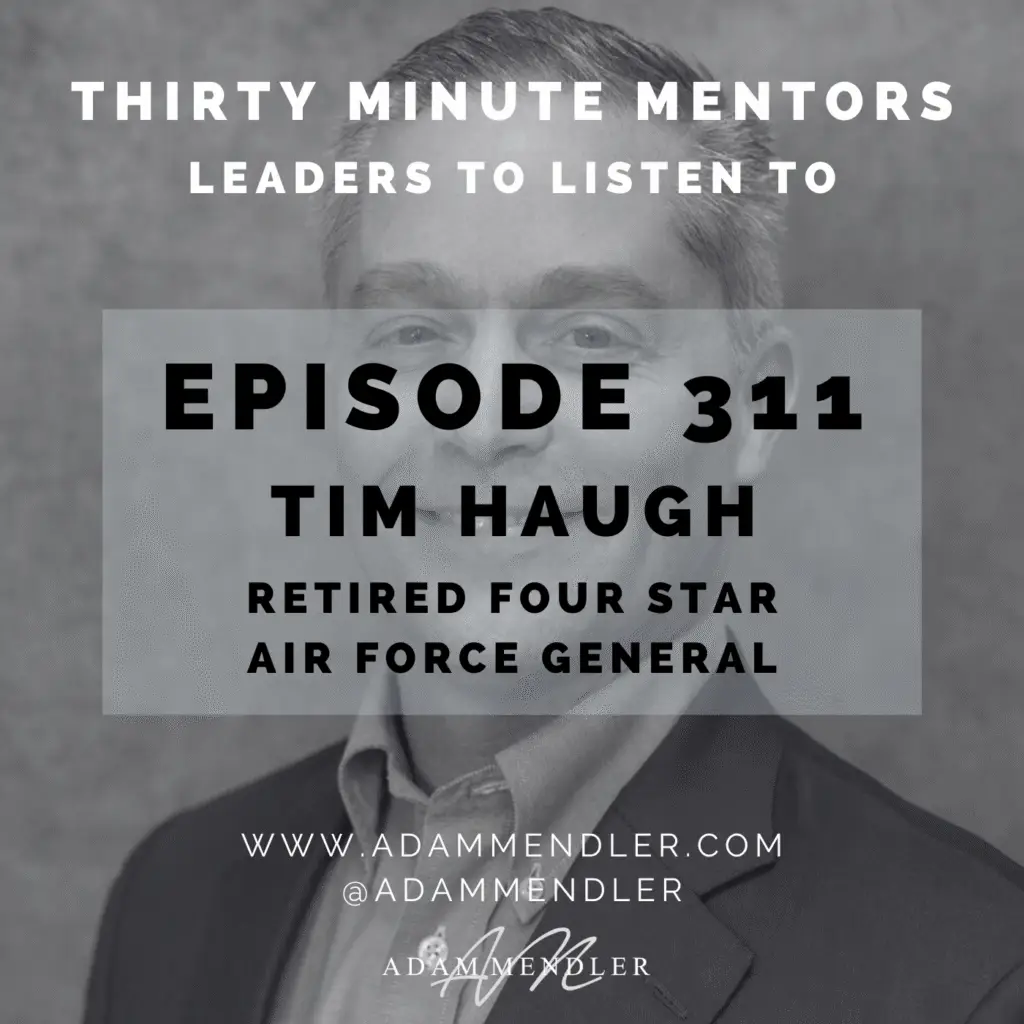
A retired four-star general who served at the highest levels within the military and the United States government, General Tim Haugh was the commander of the United States Cyber Command, the director of the National Security Agency, and the chief of the Central Security Service. General Haugh joins Adam to share his journey and his best lessons and advice on leadership and success.
Join Adam and the best network of mentors – Fortune 500 CEOs, founders of household name companies, Hall of Fame and Olympic gold medal-winning athletes, political and military leaders – for intimate half-hour conversations each week.
Thirty Minute Mentors is available wherever you listen to podcasts. If you enjoy the episode, visit your favorite podcasting app and subscribe, rate, and leave a review, and spread the word by sharing on your social media channels and sharing directly with your friends and colleagues.
Read the full transcript of Adam’s conversation with General Tim Haugh.
Episode Summary
General Tim Haugh is a retired four-star Air Force general who served as commander of U.S. Cyber Command, director of the National Security Agency, and chief of the Central Security Service. He tells Adam about a small-town upbringing, a family that valued service, and a career in Air Force intelligence and cyber operations, and he shares the leadership lessons he drew from it.
General Haugh describes a wonderful childhood growing up in small-town America, shared with a close group of friends; he and his wife, his hometown sweetheart, have been together since high school. His father had served and taught him the Marine Corps hymn early in life, and the idea of service stuck; when he found Lehigh University, its Air Force ROTC program made it feel like the perfect school. Early in his career, prior-enlisted teammates took him under their wing, and at Misawa Air Base in northern Japan, which he and his wife chose over Key West, a couple became surrogate parents to the young family.
As he moved into more senior positions, General Haugh says, he came to see three responsibilities as his own: intent, culture, and serving as a buffer from outside noise. Vision, he says, is partly about timing. When he took over what he describes as a global intelligence organization of about 6,000 people, the insurgency in Iraq and the emergence of ISIS defined the mission almost immediately. At U.S. Cyber Command, he says, Congress in part asked the command to chart that vision, and at the NSA the focus was preparing the culture for generational change as the leaders from its large growth after 9/11 transitioned out.
On culture, he describes reading Daniel Pink’s Drive with his leaders and capturing values in short statements such as empower, partner, deliver. In the organizations he has been part of, he says, he has normally found that motivation is never the hard part; alignment is. He learned that from his predecessor, General Paul Nakasone, who told the entire organization that defending the 2018 midterm elections was the number one priority. Leaders should be transparent without transferring stress, General Haugh says, and in a crisis the first step is to control your emotions, then think consciously about how to communicate the urgency.
General Haugh says leadership comes down to being curious and observant and making sure your actions reinforce your words. Innovation, he says, happens when people have a clear mandate, resources, and top cover. He recalls that when he took over wing command in 2014, an NCO taught the organization how to innovate, building on a Google concept of giving people eight hours a month to try things, with a monthly crash and burn award for whoever failed most spectacularly. He also stresses partnerships with intelligence agencies around the world, academia, and industry, which he says owns 95% of the nation’s critical infrastructure.
He credits mentors including his first supervisor, Major Larry Miller, and Dash Jamieson, who with her counterparts pushed him to learn budgeting and long-term programmatic planning when he wanted to stay in operations. His advice is that anyone can be a better leader by reading and by observing and talking with people they respect, and that we all have an opportunity to take advantage of new technology, from asking Claude what vibe coding is to diving deep into a topic with ChatGPT’s research button, as long as it is implemented in a way that is consistent with our values.
What You’ll Learn
- Surround yourself with positive leaders who still challenge you, General Haugh says: positive leadership was the first trait he evaluated, whether joining an organization or selecting leaders, but he also wanted people who question and bring different perspectives.
- Own three things as a leader, General Haugh says: the intent and vision of the organization, its culture, and serving as a buffer from outside noise so people stay focused on what they can control.
- Motivation is rarely the hard part, alignment is, General Haugh says, a lesson he took from watching General Paul Nakasone make defending the 2018 midterm elections the clear number one priority for everyone.
- In a crisis, control your emotions first, General Haugh says, then communicate urgency and timelines transparently without transferring stress to the people doing the work.
- If you want people to take risks, give them a clear mandate, resources, and top cover, General Haugh says, pointing to a monthly crash and burn award that went to whoever failed most spectacularly because they took the biggest swing.
- Let mentors push you toward skills you would rather avoid: General Haugh says leaders who pushed him to learn budgeting and long-term programmatic planning, when he wanted to stay in operations, made him a better leader in ways he would never have done himself.
About General Tim Haugh
General Tim Haugh is a retired four-star general who served for more than 30 years in the U.S. Air Force, culminating as the 4th Commander of U.S. Cyber Command and 19th Director of the National Security Agency. A native of Hughesville, Pennsylvania, he earned his commission in 1991 as a distinguished graduate of the ROTC program at Lehigh University. He commanded at the squadron, group, wing, numbered air force, and joint levels, including the Cyber National Mission Force and Sixteenth Air Force, and served as Deputy Commander of U.S. Cyber Command. In 2025, he joined Georgetown’s School of Foreign Service as a Distinguished Fellow in Residence.
Related Episodes
- Episode 35: Lieutenant General Vince Stewart
For more on leading in military intelligence, General Stewart, a retired Marine Corps general and former Director of the DIA, discusses how to succeed in the most competitive environments, how to lead winning teams of all sizes, and the keys to motivating your workforce. - Episode 258: Lieutenant General Robert Ashley Jr.
For more on intelligence leadership, General Ashley, the former Director of the Defense Intelligence Agency, discusses leadership, career success, relationship building, trust, motivation and persuasion, and introversion. - Episode 350: General CQ Brown, Jr.
For more on leading at the top of the Air Force, General Brown, who served as Chief of Staff of the Air Force and as the 21st Chairman of the Joint Chiefs of Staff, discusses approachability and relatability, crisis management, innovation, and trust. - Episode 322: Lieutenant General Karen Gibson
For more on crisis leadership and commander’s intent, General Gibson, who spent 33 years as a U.S. Army intelligence officer, discusses building a culture of agility, forgiving mistakes, and growing as a leader through reading, mentors, self-reflection, and observing others. - Episode 153: General Larry Spencer
For more on mentorship and innovation in the Air Force, General Spencer, the former Air Force Vice Chief of Staff, discusses his journey from inner-city Washington, D.C., along with leadership, mentorship, innovation, and overcoming obstacles.