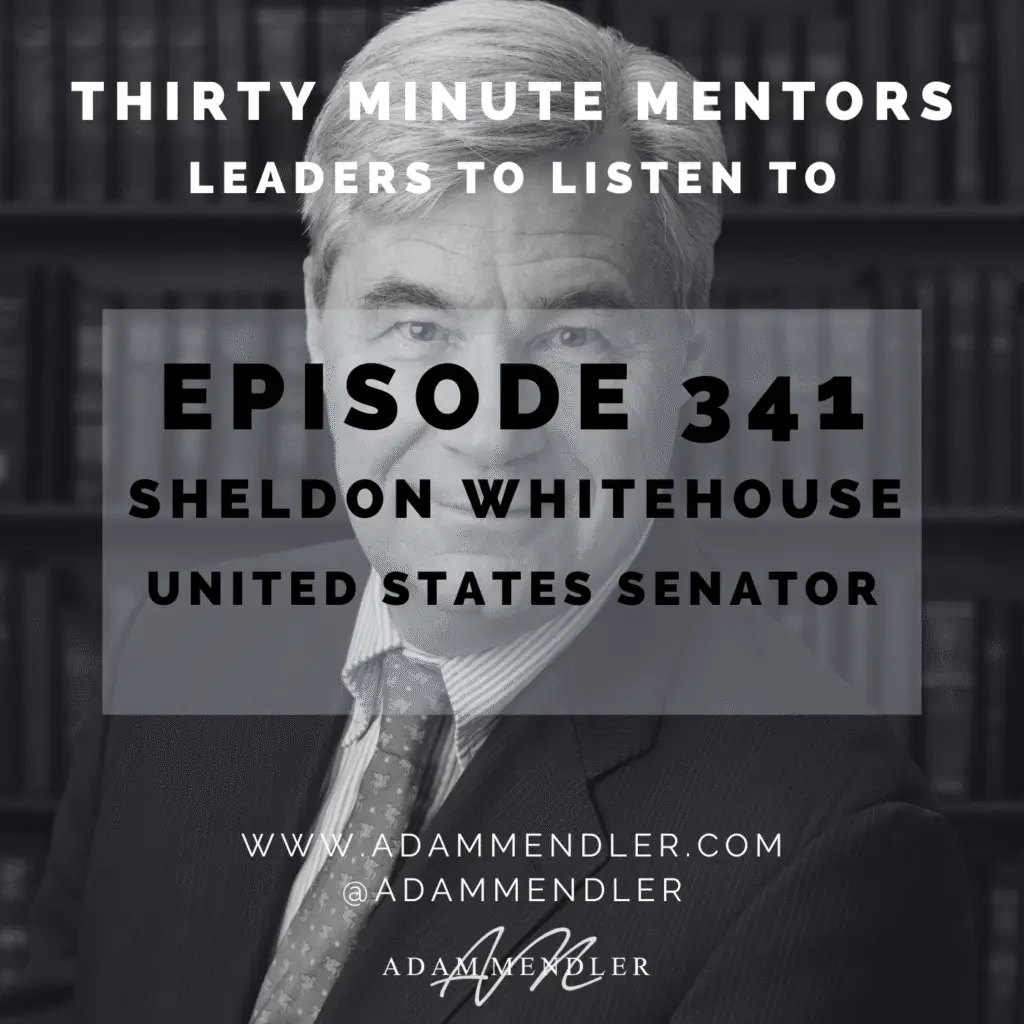
Senator Sheldon Whitehouse represents Rhode Island in the U.S. Senate, where he serves as Ranking Member of the Environment and Public Works Committee and holds senior seats on the Judiciary, Budget, and Finance Committees. Senator Whitehouse joins Adam to share his journey and his best lessons and advice. Senator Whitehouse and Adam discuss a wide range of topics: leadership, career success, communication and persuasion, how to work with people you disagree with, and much more.
Join Adam and the best network of mentors – Fortune 500 CEOs, founders of household name companies, Hall of Fame and Olympic gold medal-winning athletes, political and military leaders – for intimate half-hour conversations each week.
Thirty Minute Mentors is available wherever you listen to podcasts. If you enjoy the episode, visit your favorite podcasting app and subscribe, rate, and leave a review, and spread the word by sharing on your social media channels and sharing directly with your friends and colleagues.
Read the full transcript of Adam’s conversation with Senator Whitehouse.
Episode Summary
Senator Whitehouse’s career took its real shape from an assignment nobody else wanted. As a brand new Special Assistant Attorney General in Rhode Island, he drew public utility regulation, work he calls boring and arduous, mainly because he was the newest hire and no one else would take it. When the next political turnover washed out most of his colleagues, Senator Whitehouse was kept on precisely because he had stuck with that unglamorous docket. Decades later, the detail he learned about how utilities hide money in their rate filings became directly useful in his Senate work on energy and climate.
That pattern repeated when a newly elected Rhode Island governor, Bruce Sundlun, made Senator Whitehouse his legal counsel. Senator Whitehouse warned the governor he had no political network and did not know the building, and Sundlun said that was exactly the point: he wanted a lawyer with no other loyalties to manage. Senator Whitehouse negotiated room for a few early mistakes, got it, and the job later led to his appointment as U.S. Attorney. The Sundlun administration also inherited a collapsed state banking system and the worst budget deficit any state had reported, and Senator Whitehouse says the friendships forged working through that crisis have lasted more than 30 years, closer in some ways than ordinary friendship because they were built under real pressure.
Senator Whitehouse’s account of working across party lines centers on Jim Inhofe, the Oklahoma senator best known for bringing a snowball onto the Senate floor to dispute climate science, and his fiercest opponent on the issue. During a hearing on an unrelated ocean plastics bill, Inhofe revealed he had spent boyhood nights on the Texas shore protecting baby sea turtles from cars, then asked to be an original co-sponsor. The bill passed by unanimous consent once colleagues saw Senator Whitehouse and Inhofe agreeing on something. Senator Whitehouse’s advice is to find that person’s sea turtle rather than write off an opponent entirely.
On leadership, Senator Whitehouse points to two former colleagues with opposite styles who were each effective on their own terms: Harry Reid, blunt and combative, a former amateur boxer from a rough Nevada town, and Ted Kennedy, warm, booming, and gregarious. Neither tried to be the other. Senator Whitehouse’s own rule is similar: authenticity and a reputation for decency travel further, over a career, than any particular tactic.
What You’ll Learn
- “Presumption of regularity” is the benefit of the doubt courts extend to DOJ lawyers, earned through decades of institutional propriety, and Senator Whitehouse says losing it costs far more than winning any case is worth.
- Senator Whitehouse describes the challenge of running against Lincoln Chafee, whose father, John Chafee, had served as a Marine, governor, Navy secretary, and senator.
- Before Citizens United and super PACs, Senator Whitehouse had to personally call so many donors that his ear went sore from holding the phone, forcing him to sleep on one side for a while.
- Borrowing from a line of Winston Churchill’s about using small, simple words, Senator Whitehouse says persuasion in the Senate mostly comes down to being knowledgeable, predictive, and persistent.
- The first time they met, Harry Reid bluntly asked Senator Whitehouse why he was running such a terrible campaign, and Whitehouse’s confident reply won Reid over despite the rocky start.
- Why Senator Whitehouse credits community dinners, hot dogs in summer and pasta in veterans halls come winter, with making him a better candidate than any polished campaign appearance could.
About Senator Sheldon Whitehouse
Senator Whitehouse is the United States Senator from Rhode Island, currently the Ranking Member of the Senate Environment and Public Works Committee and a senior member of the Judiciary, Budget, and Finance Committees. He grew up around the world in a multigenerational Foreign Service family, living in Vietnam, Cambodia, South Africa, the Congo, Guinea, Laos, and Thailand before attending law school in the United States. Senator Whitehouse began his legal career in the Rhode Island Attorney General’s office, later served as legal counsel to Governor Bruce Sundlun and as U.S. Attorney, and was elected Rhode Island’s Attorney General before winning his Senate seat in 2006.
Related Episodes
- Episode 8: Former Campbell Soup CEO Doug Conant
Doug Conant discusses leadership, reputation, decency, and trust. - Episode 345: Major League Soccer Founder Alan Rothenberg
Alan Rothenberg discusses leadership, career decisions, and navigating challenging business relationships. - Episode 344: Former E*TRADE CEO Mitch Caplan
Mitch Caplan discusses entrepreneurship, leadership, growth, and navigating the 2008 financial crisis. - Episode 346: Techstars Co-Founder and CEO David Cohen
David Cohen discusses entrepreneurship, leadership, company culture, and the principles behind Techstars. - Episode 213: PEAK6 Co-Founder Jenny Just
Jenny Just discusses entrepreneurship, leadership, persistence, and building a successful financial services company.