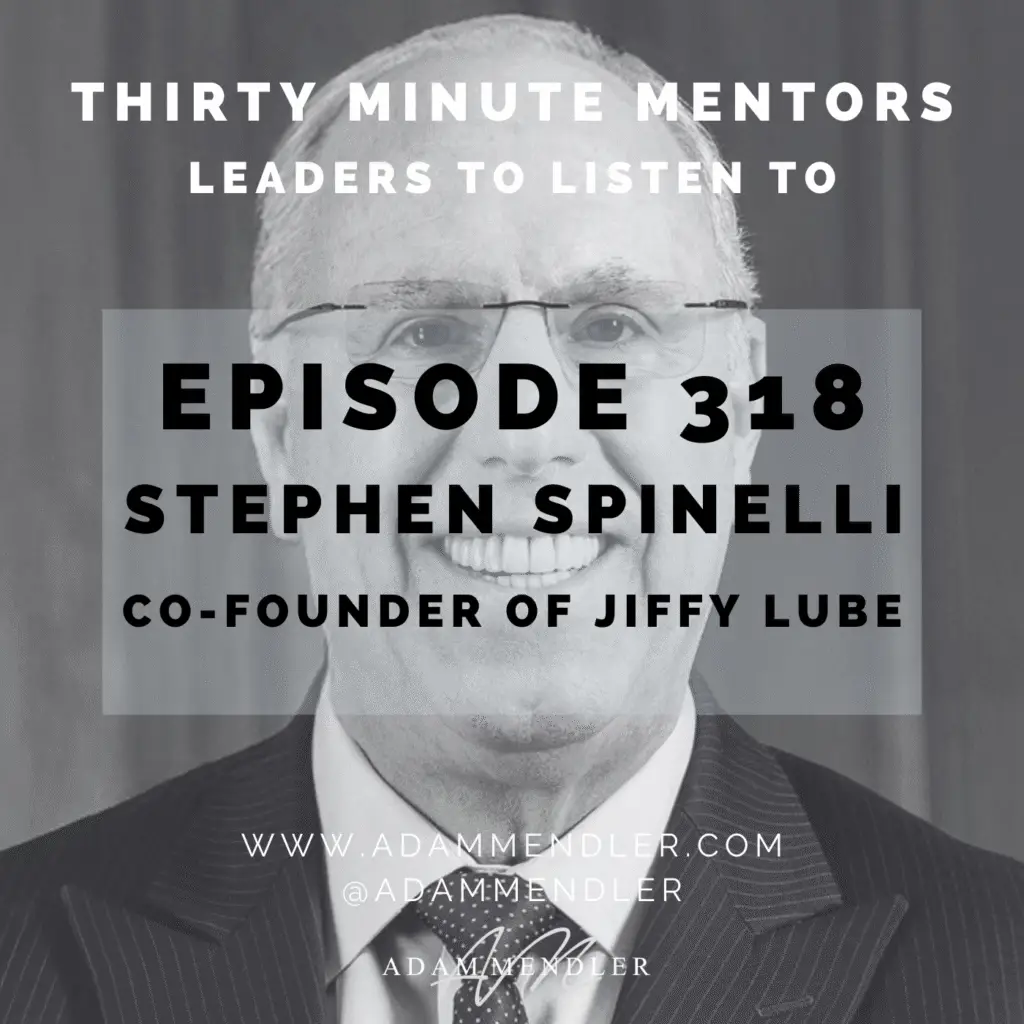
Stephen Spinelli is the co-founder of Jiffy Lube International and the President of Babson College. Stephen joins Adam to share his journey and his best lessons and advice. Stephen and Adam discuss a wide range of topics: entrepreneurship, leadership, mentorship, personal and professional growth, goal setting, value creation, customer centricity, communication, conflict, and much more.
Join Adam and the best network of mentors – Fortune 500 CEOs, founders of household name companies, Hall of Fame and Olympic gold medal-winning athletes, political and military leaders – for intimate half-hour conversations each week.
Thirty Minute Mentors is available wherever you listen to podcasts. If you enjoy the episode, visit your favorite podcasting app and subscribe, rate, and leave a review, and spread the word by sharing on your social media channels and sharing directly with your friends and colleagues.
Read the full transcript of Adam’s conversation with Stephen Spinelli.
Episode Summary
Stephen Spinelli is the co-founder of Jiffy Lube International and the president of Babson College. He tells Adam how a series of mentors, including his football coaches, shaped his path from a poor neighborhood in Springfield, Massachusetts, to Jiffy Lube, and why he sees mentoring as a two-way street in which the mentor learns from the mentee.
Stephen says sports were his training ground for learning about relationships in a competitive world. Without money for school, he went where he could get a scholarship, first to prep school and then, with his prep school football coach’s help, to Western Maryland College, now McDaniel College. His college coach, Jim Hindman, was a retired entrepreneur who brought Stephen and a few teammates into his businesses, and Stephen says he went to work running a nursing home in Baltimore the day after he graduated, living on site at 22. When the group went looking for something it could scale, Hindman found a small Jiffy Lube operation in Ogden, Utah, with cars lined up, and Stephen moved there with his new wife. He says the deal was really the coach’s money, and that he scraped together maybe $10,000 by begging and borrowing from relatives. With a couple of stores in Ogden, the partners named the company Jiffy Lube International because their goals were big; as the coach liked to say, people go too slow and shoot too low. If you want to get rich, Stephen says, you have to build something that can grow to scale, and you have to be committed.
Stephen argues that thinking big actually reduces risk: a small mistake can break a small idea, while a big opportunity leaves room to make up for it. He asks his students to define value, and says the more stakeholders you ask, the better you understand your job and the resistance you will face. At Jiffy Lube, he says, the company answered concerns about used motor oil by designing a system to account for every drop and recycle it, and people began to like the company. He also recalls that Jiffy Lube was talking about motor oil grades and gas mileage to women customers who wanted to be in and out and to trust the work, and that once the company spoke to what they valued, the business exploded.
To understand customers, Stephen says, talk to them, be around them, and take notes; he loves metrics, but he says the best information comes from having a beer or a cup of coffee with a student. He names communication, resilience, and problem-solving as the essentials of leadership, woven together rather than sequential. On conflict, he says entrepreneurship is about solving problems, and that working through hard ones is like lifting weights: it builds muscle, even if you sometimes pull one. Stephen, who is chairman of the board of Planet Fitness, also shares a saying he recalls, that an entrepreneur’s three vital organs are the brain, the heart, and the gut, and that the best decisions connect all three. Looking back, he says that when they started Jiffy Lube he worried about paying the bills and losing the house, problems that seem trivial to him now.
On leading a younger generation, Stephen says a mentor’s job is not to guide but to answer questions, share experience, and support the mentee’s decision whether or not the mentor agrees, and he says he learns a great deal from Babson students. Comparing business and higher education, he describes Babson’s thought and action paradigm: thought without action is frivolous, and action without thought is dangerous. Colleges tend to think more deeply and act less decisively, he says, while businesses do the reverse. His advice is to set specific goals and to ask each day what you learned and how you put it into action, and he says he tries to interact with a good teacher every day.
What You’ll Learn
- Think big to reduce risk, Stephen says: a small mistake can break a small idea, but a big opportunity leaves room to recover, something he says has held true in every deal he has been part of.
- Ask every stakeholder to define value, Stephen says, because their answers show you what your job is and where resistance will come from, a lesson he applied when Jiffy Lube designed a system to account for every drop of used oil.
- Talk to your customers, be around them, and take notes, Stephen says; he recalls that Jiffy Lube’s business exploded once it spoke to what its women customers valued.
- Treat conflict like lifting weights, Stephen says: working through hard problems builds muscle and resilience, and a relationship built on honest discourse lets you disagree and often reach a better solution.
- Mentor without steering, Stephen says: share your experience, answer questions, and support the mentee’s decision whether or not you agree, and treat the relationship as a partnership rather than a hierarchy.
- Be both a learner and an actor: Stephen suggests asking each day what you learned and how you put it into action, because thought without action is frivolous and action without thought is dangerous.
About Stephen Spinelli
Stephen Spinelli Jr. is the 14th president of Babson College, a role he assumed in July 2019, and he has announced plans to retire at the end of the 2026-2027 academic year. He co-founded Jiffy Lube International and was chairman and CEO of the American Oil Change Corporation. He spent 14 years on Babson’s faculty and in 2007 became president of Philadelphia University, then was named chancellor of Jefferson in 2017 after the university’s merger with Thomas Jefferson University. He is Chairman of the Board of Planet Fitness. He holds a PhD in economics from Imperial College, University of London, an MBA from Babson, and a BA in economics from McDaniel College.
Related Episodes
- Episode 40: Former Dunkin’ Donuts CEO Robert Rosenberg
For more on growing a franchise business, Bob, who spent 35 years as CEO of Dunkin’ Donuts, discusses hiring, culture, competition, branding, franchising, and leading through ups and downs. - Episode 346: Techstars Co-Founder and CEO David Cohen
For more on mentoring entrepreneurs, David, the co-founder of Techstars, discusses his Mentor Manifesto, which asks mentors to be Socratic and to support whatever the founder ultimately decides. - Episode 301: Former Secretary of Health and Human Services Donna Shalala
For more on leading people and organizations, Secretary Shalala, who served as President of the University of Miami, shares her best lessons and advice on building successful relationships, networks, and careers. - Episode 158: Orangetheory Co-Founder and CEO Dave Long
For more on building a fitness brand, Dave, the co-founder of Orangetheory, discusses entrepreneurship, leadership, branding, hiring, and pushing your comfort zone. - Episode 296: Former Sonic CEO Clifford Hudson
For more on growth and scale, Cliff, the former CEO of Sonic, discusses leadership, career success, communication, sales, and driving technological change and innovation.