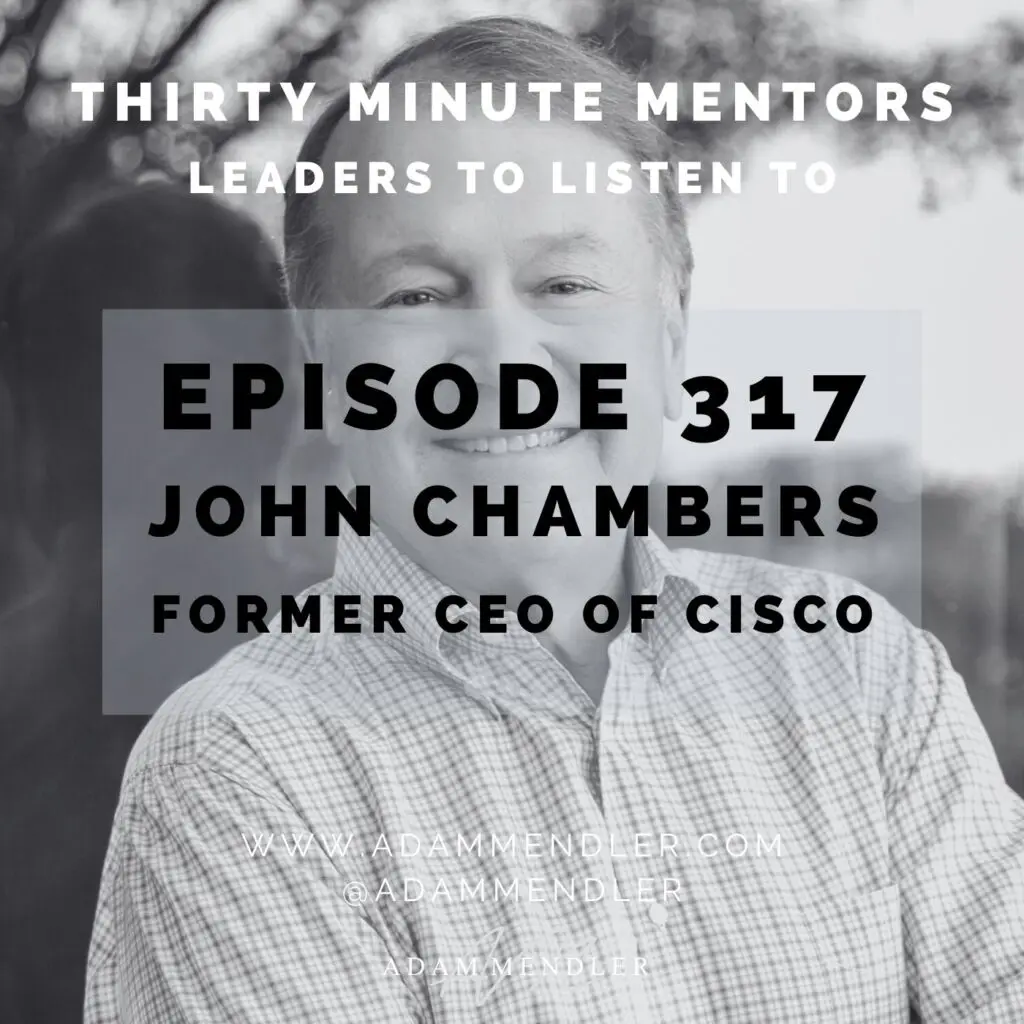
John Chambers is the former CEO of Cisco and the founder and CEO of the venture capital firm JC2 Ventures. One of the most successful leaders in Silicon Valley history and a former Fortune 100 CEO, John transformed Cisco from a $2 billion business to a nearly $50 billion enterprise. John joins Adam to share his journey and his best lessons and advice. John and Adam discuss a wide range of topics: leadership, career success, motivation, trust, resilience, innovation, AI, flexibility, and much more.
Join Adam and the best network of mentors – Fortune 500 CEOs, founders of household name companies, Hall of Fame and Olympic gold medal-winning athletes, political and military leaders – for intimate half-hour conversations each week.
Thirty Minute Mentors is available wherever you listen to podcasts. If you enjoy the episode, visit your favorite podcasting app and subscribe, rate, and leave a review, and spread the word by sharing on your social media channels and sharing directly with your friends and colleagues.
Read the full transcript of Adam’s conversation with John Chambers.
Episode Summary
John Chambers is the former CEO of Cisco, which he led for two decades, and the founder and CEO of the venture capital firm JC2 Ventures. He tells Adam he wants to make listeners a little uncomfortable, and he argues that how you handle your challenges and setbacks determines who you are even more than your successes.
John grew up in West Virginia, where both of his parents were doctors. He says he had real trouble reading in second and third grade, before dyslexia was well understood, until his parents found a teacher, Mrs. Anderson, who over two to three years taught him to work around its weaknesses and then to use its strengths. He says people with dyslexia normally connect emotionally with others, because you don’t laugh at others once you have been laughed at, and he credits dyslexia with the way he connects the dots, going from A to B and jumping to the conclusion. He still talks about it publicly, he says, even though his hands sweat when he does, because having role models matters to young people with dyslexia.
John says the skills behind his success are often basic. Never confuse hard work with results, a mindset he connects to Jack Welch’s philosophy of being number one or two or not competing. Build and develop a great team, treat culture as being as important as strategy, share success generously, communicate well, put the customer first, and do the right thing. He once saw process as bureaucracy, but strong operators around him, including his first CFO, Larry Carter, showed him that playbooks for acquisitions, crisis management, and entering new markets let a company move with tremendous speed. He recalls a tip from the head of NASDAQ one Thursday night that led to a handshake at lunch the next day on a $3.2 billion acquisition.
A childhood lesson from his father shapes how John handles a crisis. At six, he says, he moved too far out while fishing the rapids of the Elk River and was swept downstream; his father told him to hold on to the fishing pole, then taught him to stay calm the more hectic things get, keep his feet up to take the rocks, and angle toward where he wanted to get out, before putting him back in to do it again. He calls missing the dot-com bust the biggest business mistake of his life, recalling that Cisco went from growing 70 percent year over year in the first week of December 2000 to shrinking 45 percent by mid-January, and that he had to lay off 7,584 people he had hired. He says he questioned whether he was the right leader before committing to lead the recovery, and that Cisco recovered quicker than anybody else.
On motivation, John says his approach is usually not fiery but emotionally connected: outline a vision, be realistic about what caused the problem, and build trust, including by helping people through serious health issues. He cautions that multiple cultures can win, including tough, bottom-line cultures, as long as leaders are consistent, and he says culture starts at the top. He believes AI will move at five times the speed and three times the outcome of the internet, drive productivity gains of 10 percent or more a year for well-run companies, and in the short term likely destroy more jobs than it creates, which he calls his number one worry. Leaders, he says, should own AI themselves rather than appoint someone else to do it.
His advice for anyone is to be curious and learn from others, embrace technology even when it makes you uncomfortable, build replicable playbooks for work and life, have the courage to dream, and treat people the way you would like to be treated.
What You’ll Learn
- A weakness is only a weakness if you make it so, John says: with help from his family and a special teacher, he learned to work around dyslexia and then to play to its strengths, including connecting emotionally with others and connecting the dots.
- Never confuse hard work with results, John says, and set aggressive goals, an approach he ties to Jack Welch’s philosophy of being number one or two or not competing.
- The more hectic things get, the calmer you need to be, John says, focusing on the solution and what can hurt you, a lesson his father taught him after he was swept into the rapids as a six-year-old.
- Treat process as a source of speed rather than bureaucracy, John says: when everyone knows their role in a replicable playbook, a company can move with a speed that is almost unbeatable.
- Be transparent about your mistakes and get the truth on the table, John says, asking what you should have done differently, as he did after missing the dot-com bust.
- Lead on AI by example instead of delegating it, John says, and have the courage to keep reinventing yourself, because those who do not use AI will get left behind.
About John Chambers
John Chambers is the founder and CEO of JC2 Ventures, a venture capital firm that invests in and coaches startups, and the former CEO of Cisco. He joined Cisco in 1991 as head of sales, served as CEO from January 1995 to 2015 and then as executive chairman, and is now chairman emeritus. During his tenure, Cisco grew from 400 employees and $70 million to 75,000 employees and $47 billion, and he completed 180 acquisitions. He is chairman of the US-India Strategic Partnership Forum and a recipient of India’s Padma Bhushan. He holds business and law degrees from West Virginia University and an MBA from Indiana University.
Related Episodes
- Episode 127: Former Skype CEO Tony Bates
For more on mentorship in technology, Tony, the former CEO of Skype, discusses leadership, customer centricity, the power of empathy, and lessons from the former CEOs of Microsoft, Cisco, and eBay. - Episode 255: Former PayPal and Intuit CEO Bill Harris
For more on dyslexia and entrepreneurship, Bill, the former CEO of Intuit and PayPal, discusses innovation, hiring, learning from failure, and why dyslexic people may be good at starting companies. - Episode 74: Former GE CEO Jeff Immelt
For more on leading one of America’s largest companies, Jeff, who succeeded Jack Welch and spent 17 years as CEO of GE, discusses culture, learning from failure, decision-making, and dealmaking. - Episode 189: Former Snowflake CEO Bob Muglia
For more on AI, Bob, the former CEO of Snowflake, discusses what leaders should understand about AI and big data, hiring and motivating talent, and lessons learned from Bill Gates and Steve Ballmer. - Episode 176: AOL Co-Founder Steve Case
For more on building and backing companies, Steve, who co-founded and led AOL and is the chairman and CEO of the venture capital firm Revolution, discusses entrepreneurship, leadership, investing, building winning teams, and negotiations.