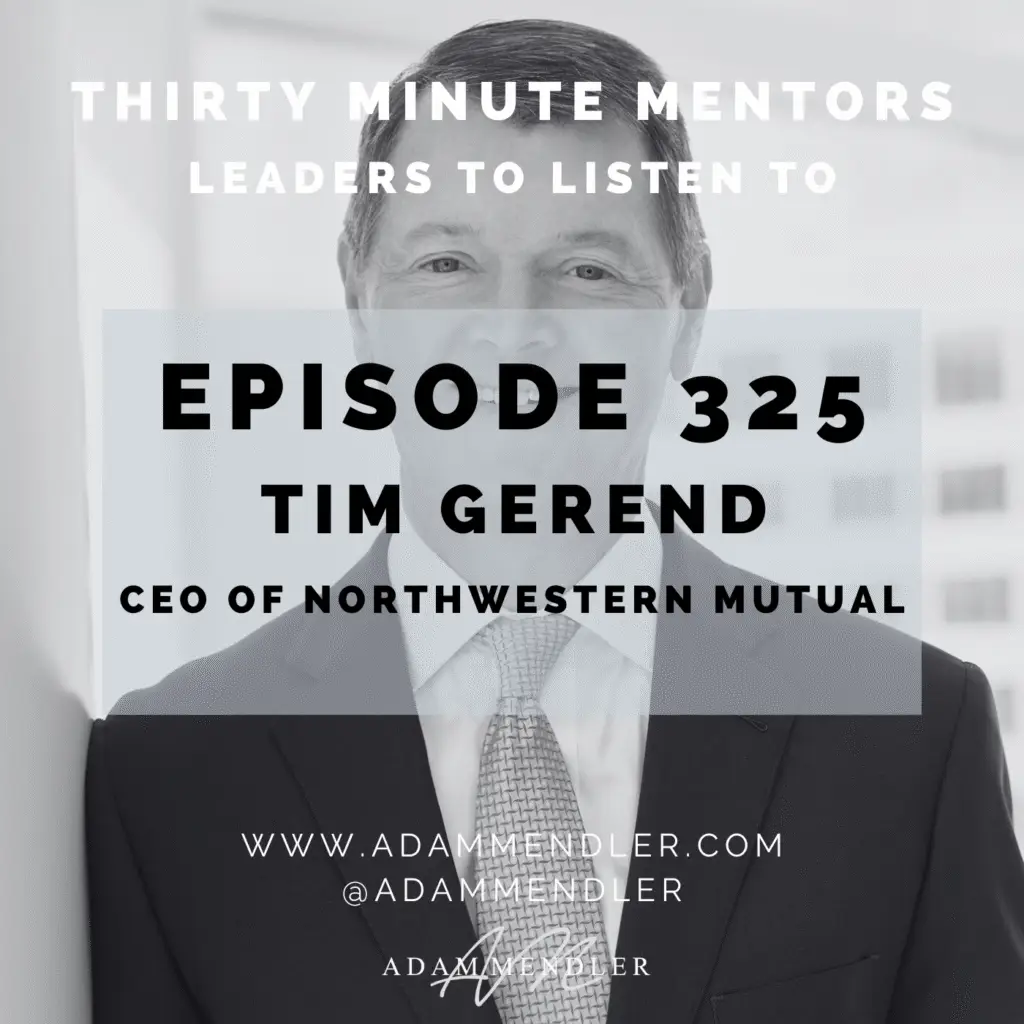
Tim Gerend is the CEO of Northwestern Mutual, one of America’s largest financial services companies, with more than $38 billion in annual revenue. Tim joins Adam to share his journey and his best lessons and advice. Tim and Adam discuss a wide range of topics: leadership, career success, communication and persuasion, decision making, hiring, trust, and much more.
Join Adam and the best network of mentors – Fortune 500 CEOs, founders of household name companies, Hall of Fame and Olympic gold medal-winning athletes, political and military leaders – for intimate half-hour conversations each week.
Thirty Minute Mentors is available wherever you listen to podcasts. If you enjoy the episode, visit your favorite podcasting app and subscribe, rate, and leave a review, and spread the word by sharing on your social media channels and sharing directly with your friends and colleagues.
Read the full transcript of Adam’s conversation with Tim.
Episode Summary
Tim Gerend is the CEO of Northwestern Mutual, one of America’s largest financial services companies. In this episode of the Thirty Minute Mentors podcast, he tells Adam how a lawyer who grew up in small Midwestern towns became a Fortune 500 CEO, and what he has learned about leadership, trust, decision-making, and personal growth along the way.
Tim describes a Midwestern upbringing built on family, faith, work ethic, and teamwork. He spent the first year of his life living with his grandparents in Sheboygan, Wisconsin, while his father was in Vietnam, and his grandfather, a doctor in the Pacific during World War II, often told him that to whom much is given, much is expected. That sense of gratitude and responsibility shaped his drive to make the most of his potential and to have a positive impact on others.
On rising in a career, Tim says the first priority is doing a good job where you are, because it is hard to get noticed if you are not a top performer in your current role. The second is curiosity and learning agility, which opened opportunities well beyond the law department where he started. He explains the leader as a gardener rather than a chess master, an idea he took from General Stanley McChrystal’s writing, and recalls being promoted to lead 22 direct reports who all knew more than he did about their daily work.
He also shares his views on trust, which he calls the most important currency of leadership. His formula is to say what you mean and do what you say you are going to do, while building an environment where people feel comfortable telling you the truth and bringing bad news. On decisions, he wants them made close to the action by the people who have the facts, and he warns that a leader who waits too long can become a bottleneck and control the speed limit of the organization.
Tim closes with lessons on persuasion, which depends on knowing your audience and speaking authentically with both head and heart, and on co-creation with Northwestern Mutual’s 23,000 advisors and team members. His advice for listeners is to get clear on your values, decide what kind of leader you want to be, and lean into uncomfortable feedback.
What You’ll Learn
- Why Tim says the first key to rising in a career is doing a great job where you are, backed by curiosity and learning agility.
- How the idea of a leader as a gardener rather than a chess master shapes the way Tim creates an environment where others can be great.
- What Tim learned when he was promoted to lead 22 direct reports in the law department who each knew more than he did about their work.
- Why Tim believes the simplest way to build trust is to say what you mean and do what you say you are going to do.
- How Tim thinks about decision-making, including why decisions should be made close to the action and why a leader who delays can become a bottleneck.
- Why Tim advises listeners to decide what kind of leader they want to be and to lean into constructive feedback, even though it never feels good.
About Tim Gerend
Tim Gerend is the CEO of Northwestern Mutual, the Milwaukee-based financial services company. He grew up in small towns across the upper Midwest, earned a full ride to Butler University, and received his law degree from Notre Dame. He began his career as a litigator with a big firm in Chicago before joining the law department at Northwestern Mutual, where he spent about five years before moving to the business side. Over more than two decades at the company, he took on a wide range of roles before becoming CEO.
Related Episodes
- Episode 332: LPL Financial CEO Rich Steinmeier
Rich describes pushing decision-making as low as possible, starting with a shared five-year vision and working backward to milestones so he does not have to micromanage. - Episode 335: Lieutenant General Jody Daniels
General Daniels pushed signature authority down as far as regulation allowed, writing a memo for each policy, and says doing so saved her time later. - Episode 330: Priceline Co-Founder Paul Breitenbach
Paul says coachability is one of the most important traits for a leader, starting with the self-awareness to know your strengths and weaknesses and the discernment to be careful who you ask. - Episode 340: General Gary Brito
General Brito describes a master sergeant telling him as a second lieutenant to take care of his troops and not his evaluation, a guidepost that became his true north. - Episode 326: Kate Spade Co-Founder Elyce Arons
Elyce describes building Kate Spade from a first trade show booth that cost $2,500, and why the company does its catalogs and marketing in-house rather than hiring outside agencies and photographers.