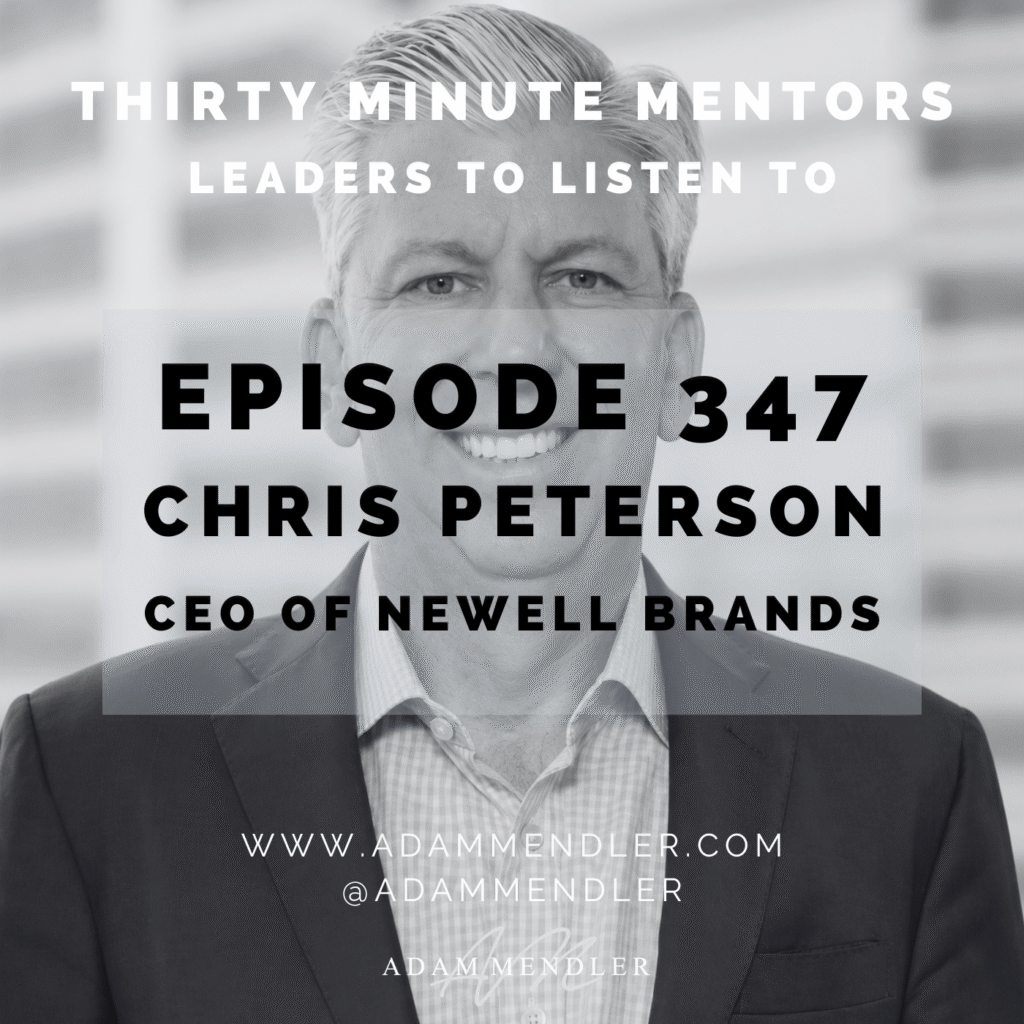
Chris Peterson is the CEO of Newell Brands, a global consumer products company behind brands including Rubbermaid, Sharpie, Graco, Yankee Candle, and Coleman. Chris joins Adam to share his journey and his best lessons and advice. Chris and Adam discuss a wide range of topics: leadership, turnaround strategy, decision-making, prioritization, talent management, career growth, and more.
Join Adam and the best network of mentors – Fortune 500 CEOs, founders of household name companies, Hall of Fame and Olympic gold medal-winning athletes, political and military leaders – for intimate half-hour conversations each week.
Thirty Minute Mentors is available wherever you listen to podcasts. If you enjoy the episode, visit your favorite podcasting app and subscribe, rate, and leave a review, and spread the word by sharing on your social media channels and sharing directly with your friends and colleagues.
Read the full transcript of Adam’s conversation with Chris Peterson.
Episode Summary
Early in his career, Chris Peterson was assigned to work in accounting at a Procter & Gamble CoverGirl Cosmetics plant in Baltimore, a job with no connection to the factory floor. A month or two in, he asked his plant manager for a couple of days working the manufacturing line itself as a day laborer, just to understand what the job actually involved. He was not particularly good at it, and the line ran slower with him on it, but the experience stuck. About a year later, while giving a senior executive a tour of the plant, Chris pointed out a formula card and correctly named its first ingredient, talc, without hesitation. That single moment of firsthand knowledge is what got him marked as someone worth developing further.
Chris became CEO of Newell Brands, the parent company of Sharpie, Rubbermaid, and Crock-Pot, in 2023, and used his first day to tell Wall Street plainly that the company was in a turnaround. He then had his team spend two months assessing Newell against competitors on eleven capabilities considered necessary to win in the industry. On roughly half of them, Newell ranked dead last.
The strategy that followed was built around concentration rather than expansion. Twenty-five of Newell’s brands accounted for ninety percent of its sales and profit, and ten of its forty-two countries accounted for the same share, so those became the explicit focus. Newell consolidated seven separate U.S. selling teams into one and twenty-three independent supply chains into one, built a brand management function that had not existed before, and turned over about seventy-five percent of its top five hundred roles, roughly split between internal promotions and outside hires.
One product born from that rebuilt innovation process is the Graco EasyTurn car seat. Researchers watching parents install rear-facing car seats noticed how difficult and painful the twisting motion was, especially for new mothers recovering from a C-section, and the team developed a seat that swivels out of the back seat entirely before locking back into place. It launched in 2025 as the number one-performing new item in baby gear launched that year. Chris credits the surrounding decision culture as much as any single idea: rather than waiting for complete information, he aims to act once he has roughly seventy to eighty percent of what he needs, and he measures his innovation portfolio the way a batting average works, expecting realistically that around seventy percent of new initiatives will succeed rather than treating every miss as a failure of judgment.
What You’ll Learn
- Why Chris believes real authority in a room comes from being the most informed person on a topic, not from having the highest title.
- Chris built his weekly and yearly schedule as a Fortune 500 CEO entirely around a handful of competing stakeholder groups, rather than around his own priorities.
- Chris tells his teams he doesn’t mind anyone trying something and failing, as long as the same mistake never happens twice.
- Why Chris deliberately chose to compete at middle and high price points across Newell’s categories rather than trying to win everywhere on price.
- Chris still personally visits Newell’s more than 40 manufacturing plants, arguing it’s the only way to avoid becoming disconnected from what’s actually happening in the business.
- Staying curious and continuing to learn inside your current job, Chris argues, matters more for career growth than calculating your next move.
About Chris Peterson
Chris Peterson is the CEO of Newell Brands, the more than seven billion dollar parent company of brands including Sharpie, Rubbermaid, Crock-Pot, and Graco. He grew up in Cincinnati, Ohio, and studied engineering at Cornell, graduating in the top five percent of his class while playing on the varsity golf team for four years. Chris spent his early career at Procter & Gamble before rising through a series of operating and finance roles. Since becoming Newell’s CEO in 2023, he has led a public turnaround built around concentrating the company on its strongest brands, countries, and capabilities.
Related Episodes
- Episode 239: Panera Founder Ron Shaich
Ron discusses founding Panera Bread, helping define the fast-casual restaurant segment, and selling the company for $7.5 billion. - Episode 111: RH CEO Gary Friedman
Gary describes taking over RH when it was on the verge of bankruptcy and transforming it into one of America’s most successful retailers. - Episode 72: New Mountain Founder and CEO Steve Klinsky
Steve discusses co-founding Goldman Sachs’ buyout group, building New Mountain Capital, and how to succeed in private equity. - Episode 92: Shake Shack CEO Randy Garutti
Randy describes how he and Danny Meyer grew Shake Shack from a hot dog stand into a multibillion-dollar business, and what he learned navigating the PPP controversy. - Episode 346: Techstars Co-Founder and CEO David Cohen
David explains why he hires for motivation first, ahead of credentials.