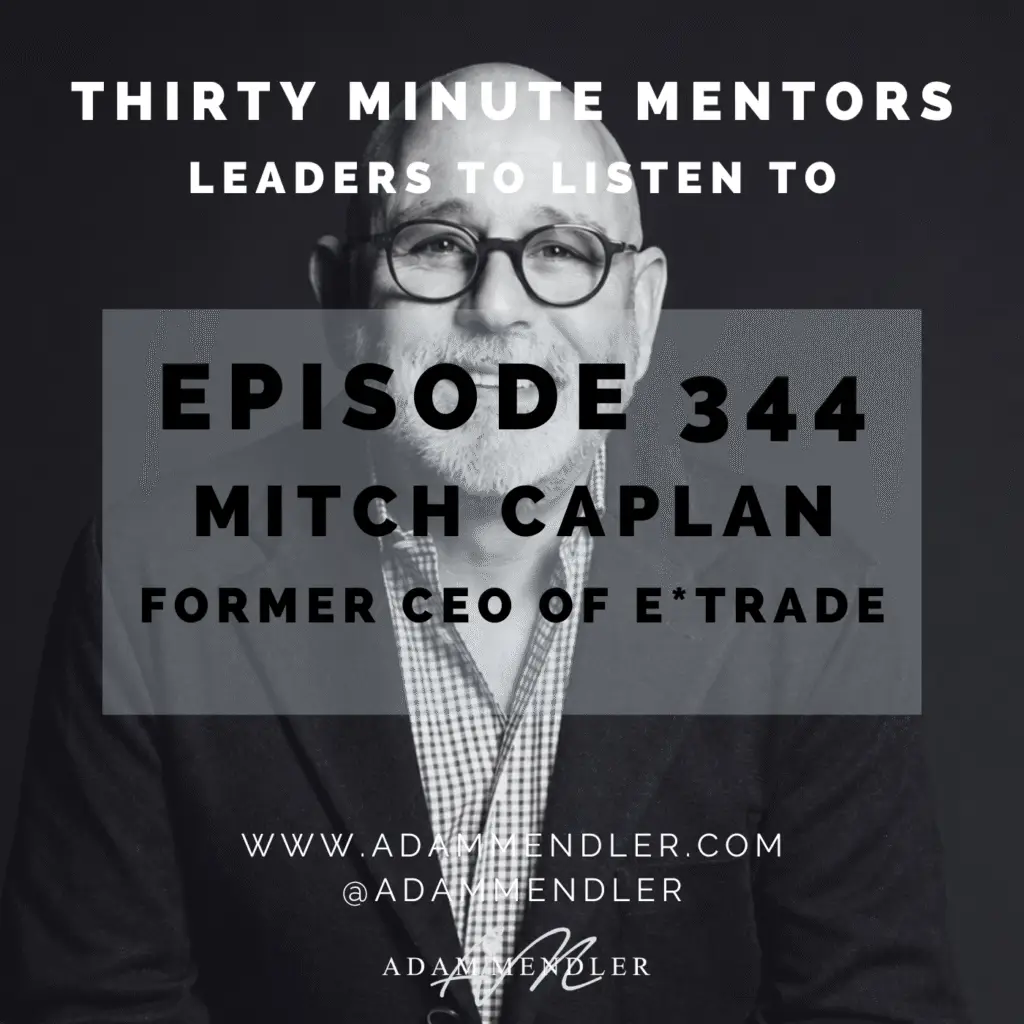
Mitch Caplan was the CEO of E*TRADE, where he helped pioneer the first fully integrated online brokerage platform and led through the highest of highs (building a $3 billion business) and the lowest of lows (the 2008 financial crisis). Mitch is currently the CEO of Willow Wealth. Mitch joins Adam to share his journey and his best lessons and advice. Mitch and Adam discuss a wide range of topics: leadership, humility, collaboration, growth and scale, innovation, navigating crisis and chaos, and much more.
Join Adam and the best network of mentors – Fortune 500 CEOs, founders of household name companies, Hall of Fame and Olympic gold medal-winning athletes, political and military leaders – for intimate half-hour conversations each week.
Thirty Minute Mentors is available wherever you listen to podcasts. If you enjoy the episode, visit your favorite podcasting app and subscribe, rate, and leave a review, and spread the word by sharing on your social media channels and sharing directly with your friends and colleagues.
Read the full transcript of Adam’s conversation with Mitch Caplan.
Episode Summary
Mitch Caplan left a partner track position at the law firm Shearman & Sterling in 1990 to buy a failed bank with a partner, using assets sold off by the Resolution Trust Corporation after the savings and loan crisis. The bank was based in the Washington, DC area, and Mitch quickly learned that a small branch bank could not work economically there given expensive real estate and a transient population. Rather than retreat to rural branches, he pitched regulators on becoming the first branchless bank in the United States, modeled on a UK operator called First Direct that almost no one in American banking had heard of. The regulator who approved the plan told him directly he expected it to fail. Mitch built the bank, Telebank, from 50 million dollars in assets to roughly 7 or 8 billion over a decade, taking it public along the way.
When Telebank was acquired by E*TRADE, Mitch insisted on learning the brokerage business from the ground up rather than simply overseeing it. He stayed at a Marriott hotel in Sacramento for four to six weeks to walk through every step of a customer’s experience in the operations center personally, arguing that credibility with a team can’t be faked and that living in the details is the only way to earn it.
After Mitch became CEO of E*TRADE in 2003, the company grew substantially before the financial crisis, with annual revenue increasing from $1.3 billion to $3 billion. Mitch estimates he was only about 50 percent right predicting in advance which members of his leadership team would rise to a real crisis and which would freeze. He spent much of that period convincing E*TRADE’s board to raise capital before year end, given how uncertain pricing had become, and ultimately left the company on his own terms once the worst had passed, partly because his family told him directly that he needed to step back and create real distance from the business before starting anything new.
Mitch rebuilt again afterward, deliberately keeping his next company, Jefferson National, private rather than public, working again with many of the same colleagues who had built Telebank with him, before selling it to Nationwide seven or eight years later. He carries a specific bias into his investing today at Willow Wealth: he says he is now far more likely to back a founder who has lived through real hardship than one who has only experienced steady, uninterrupted success.
What You’ll Learn
- Why Mitch treats saying “I don’t know” as one of leadership’s most important phrases now, in sharp contrast to how it felt to him earlier in his career.
- Mitch says one of his first interview questions is whether a candidate works better in structure or chaos, since he rarely bets on someone who hasn’t at least embraced chaos.
- A close friend and colleague describes Mitch as someone who “pops up like toast every morning,” a description he credits to always having a North Star that keeps him passionate.
- Why Mitch says nearly two decades of almost zero loan losses at his bank made the 2008 financial crisis feel like everything he thought was true had suddenly become untrue.
- Why Mitch still remembers throwing a celebration the day his bank crossed 100,000 customers, even while constantly pushing his team to think in far bigger terms.
- A leader who fails to build consensus still owns the decision, Mitch believes, and has to explain why they made it rather than simply announcing it.
About Mitch Caplan
Mitch Caplan is the former CEO of E*TRADE and the current CEO of Willow Wealth. He grew up in Portsmouth, Virginia, studied history at Brandeis University, and earned an MBA and JD at Emory University before practicing law in New York for five years. Mitch built and took public a bank called Telebank, which was acquired by E*TRADE, where he later served as CEO from 2003 through the 2008 financial crisis. He went on to build and sell Jefferson National to Nationwide, and his family office led an early funding round in what became Yieldstreet before he took over Willow Wealth.
Related Episodes
- Episode 345: Major League Soccer Founder Alan Rothenberg
Alan describes founding Major League Soccer and organizing the 1994 World Cup, and how he weighs risk before a major decision. - Episode 213: PEAK6 Co-Founder Jenny Just
Jenny discusses co-founding PEAK6, along with decision-making, risk management, investing, and poker. - Episode 346: Techstars Co-Founder and CEO David Cohen
David explains why he hires for motivation first, ahead of credentials. - Episode 111: RH CEO Gary Friedman
Gary describes taking over RH when it was on the verge of bankruptcy and transforming it into one of America’s most successful retailers. - Episode 72: New Mountain Founder and CEO Steve Klinsky
Steve discusses co-founding Goldman Sachs’ buyout group, building New Mountain Capital, and how to succeed in private equity.