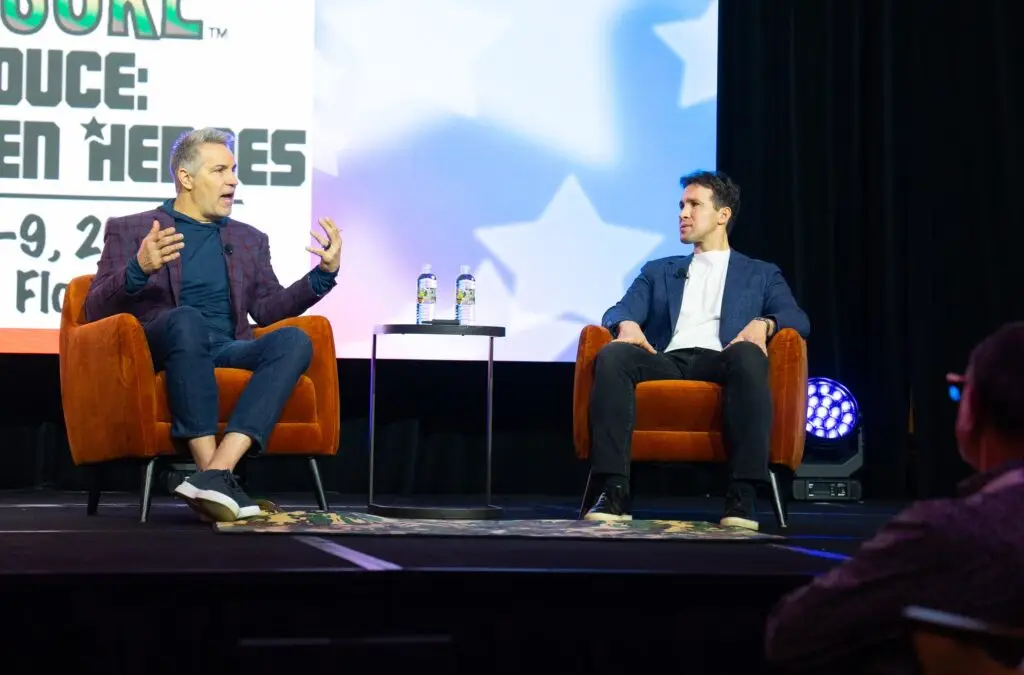


Most lists of virtual keynote speakers focus on who is famous. But being a great speaker onstage doesn’t always mean someone will be great on a screen. I’ve delivered keynotes both in person and virtually, and they’re very different experiences. In person, you can feel the energy of the audience and adjust as you go. Virtually, you get far less feedback and face far more competition for people’s attention. A strong virtual speaker knows how to keep people engaged without relying on the energy of the room.
Virtual keynote fees can range from around $10,000 to well into six figures, so choosing the right speaker matters. If you’re planning a virtual or hybrid event and want someone who’s built for it, here are some of the speakers worth considering.
A virtual keynote speaker delivers a keynote to a remote or hybrid audience over video. The top virtual keynote speakers for 2026 include Mel Robbins, Adam Mendler, Adam Grant, Seth Godin, Gary Vaynerchuk, Ross Dawson, Shawn Kanungo, and Carey Lohrenz. Below, I cover what separates a strong online keynote from a weak one, who each speaker is best for, what they cost, and how to choose.
What Makes a Great Virtual Keynote Speaker
A virtual keynote shouldn’t simply be an in-person keynote delivered over video. A remote audience gives you far less feedback, so a speaker can’t read the room and adjust in real time, and the usual signals that tell you people are with you- the laughter, the nods, the shift in posture- aren’t there. Harvard Business Review has described why virtual presenting feels so strange: without eye contact and audience response, even experienced speakers feel like they’re talking into a black hole, and the fix is deliberately rebuilding the back-and-forth of a real conversation. The speakers who do this well plan interaction into the talk instead of hoping it happens.
Attention is harder to hold on a screen, so strong virtual speakers keep the pace moving and get to useful ideas quickly. Production matters more than people expect too. Strong online keynote speakers use a real camera setup, clean audio, and engaging visuals, instead of a laptop webcam and a wall of bullet points.
The format matters too. What makes any keynote engaging still applies, but virtual adds choices that change the experience:
- Live-streamed keynote: The speaker presents in real time with live Q&A and polling. This is the closest thing to a stage and the best fit when you want energy and genuine interaction.
- Pre-recorded keynote with live Q&A: Here, the talk is filmed and produced in advance, then the speaker joins live to take questions. You trade some spontaneity for polish and reliability, which helps for global audiences or high-stakes events.
- Hybrid keynote: One speaker addresses both an in-person room and a remote audience at once. It’s the hardest format to pull off, because a speaker who plays only to the people in front of them loses everyone on the screen.
Hybrid events have also become increasingly common, because many organizations aren’t choosing between fully in-person and fully virtual anymore. They’re running events that combine both, and a remote keynote speaker has to hold two audiences with different needs in the same hour.
How I Chose These Virtual Speakers
Plenty of “top virtual keynote speakers” lists are built by bureaus that earn a commission on the booking or by writers ranking names they’ve never watched work a live camera. I built this one to filter that out. I evaluated each speaker based on five criteria:
- Proven virtual or hybrid delivery: Real keynotes delivered over video, not an in-person talk with a webcam bolted on.
- A setup built for the screen: Production, pacing, and interaction designed for a remote audience rather than borrowed from the stage.
- Recent footage available: A full talk or a substantive segment that shows how they hold a room through a camera.
- Documented credibility: Books, client rosters, or third-party recognition tied to real work.
- A clear audience fit: Strong for a specific type of audience or event.
Nobody paid to appear on this list, and I don’t receive referral fees from any of the speakers included.
The Top Virtual Keynote Speakers for 2026
The eight speakers below range from virtual motivational speakers to subject-matter experts, and this isn’t a strict ranking. Each one fits a different kind of audience and a different budget, which matters more than the order. For the wider field, my roundups of the top motivational speakers and leadership keynote speakers for 2026 cover speakers who work primarily on a live stage.
1. Mel Robbins
Mel Robbins is one of the most popular speakers and podcasters working today, and her book The Let Them Theory was a major bestseller. Because most of her audience already knows her from video, she’s very comfortable in front of a camera.
Background
Robbins started as a criminal defense attorney, then spent years as a CNN legal analyst and hosted her own daytime talk show. Her 2011 TEDx talk introduced the 5 Second Rule and pulled in tens of millions of views, and she launched The Mel Robbins Podcast in 2022, which quickly became one of the most popular podcasts in the country.
Signature Topics
- Behavioral change and the science of motivation
- Building confidence and overcoming self-doubt
- Boundaries, energy, and taking back control
Notable Accomplishments
- Bestselling author of The 5 Second Rule, The High 5 Habit, and The Let Them Theory
- TEDx talk with more than 15 million views
- Host of one of the most popular podcasts on Apple and Spotify
- Former CNN legal analyst and host of The Mel Robbins Show
- Reaches millions of followers across Instagram, TikTok, and YouTube
Speaking Fee Range
- Live event: $200,000+
- Virtual: $100,000 to $200,000
Best For
Sales kickoffs at consumer brands, women’s leadership conferences, large general-audience corporate events, and wellness summits that want high-energy practical psychology rather than academic theory.
Signature Framework
The 5 Second Rule is her foundational tool. When the instinct to act shows up, you count 5-4-3-2-1 and move before the brain talks you out of it. The High 5 Habit and The Let Them Theory extend that idea into self-perception and relationships.
Why Mel Robbins Works Virtually
She’s spent years speaking directly to a camera through her podcast and videos, so presenting online comes naturally to her. She keeps her energy up even without a live audience in the room.
Watch Mel Robbins in Action
Source: AAE Speakers
2. Adam Mendler
Adam Mendler is a keynote speaker whose work draws on years of recorded conversations with Fortune 500 CEOs, four-star generals, Olympic gold medalists, and political leaders. He translates what he’s learned into practical takeaways leaders can apply.
Background
Adam is the creator and host of Thirty Minute Mentors and has interviewed more than 500 leaders across business, government, the military, sports, and entertainment. He has written more than 70 articles for Forbes, Inc., and HuffPost, teaches graduate-level leadership courses at UCLA, and advises companies and executives on leadership and team performance.
Signature Topics
- Leadership lessons from more than 500 interviews with CEOs, founders, military and political leaders, athletes, and other high achievers
- Building high-performing teams through change and uncertainty
- Decision-making and accountability for senior and emerging leaders
Notable Accomplishments
- Creator and host of Thirty Minute Mentors, with more than 500 interviews with top leaders and high achievers
- Author of 70+ articles for Forbes, Inc., and HuffPost
- Featured in Business Insider, FOX, NBC, U.S. News, and Sports Illustrated
- Has keynoted for organizations including DIRECTV, JLL, and the U.S. Army
- Teaches graduate-level leadership courses at UCLA
Speaking Fee Range
- Live event: $15,000+
- Virtual: $10,000 – $15,000
Best For
Leadership conferences, company and sales meetings, executive retreats, and association events focused on helping leaders and teams perform at a higher level.
Signature Framework
Adam draws on what he’s learned from more than 500 interviews to show audiences the habits and patterns behind top performers, using real stories and specific, practical takeaways.
Why Adam Mendler Works Virtually
Adam has extensive experience engaging audiences virtually, from hundreds of remote interviews to virtual keynotes and programs. He brings that same engagement to a virtual keynote, and he works closely with event teams on platform logistics and audience interaction. Past clients describe his virtual sessions as practical and easy to apply.
Watch Adam Mendler in Action
3. Adam Grant
Adam Grant is an organizational psychologist who makes academic research genuinely useful for business audiences. He’s been Wharton’s top-rated professor for seven years running and has written five bestsellers, and he’s known for explaining his ideas clearly without oversimplifying them.
Background
Grant earned his PhD in organizational psychology and joined Wharton in 2009, where he holds an endowed professorship. His research covers motivation, generosity, original thinking, and how people keep learning across long careers. He hosts TED’s ReThinking podcast and contributes to the New York Times.
Signature Topics
- Givers, takers, and the economics of generosity at work
- Original thinking and the psychology of innovation
- Rethinking and the discipline of changing your mind
Notable Accomplishments
- Bestselling author of Give and Take, Originals, Option B, Think Again, and Hidden Potential
- Named one of the world’s 10 most influential management thinkers by Thinkers50
- Speaking and consulting for clients including Google, NASA, Pixar, and the NBA
- Host of the ReThinking podcast on the TED Audio Collective
- Wharton’s top-rated professor for seven years running
Speaking Fee Range
- Live event: Available on request
- Virtual: Available on request
Best For
Executive education, corporate leadership summits, HR and talent conferences, and C-suite audiences that want research-backed ideas presented in an engaging way.
Signature Framework
Givers, Takers, and Matchers from Give and Take sorts workplace behavior into three types, and the Rethinking Cycle from Think Again contrasts preacher, prosecutor, and politician modes with a scientist’s willingness to test and revise a belief.
Why Adam Grant Works Virtually
Grant is a clear, engaging speaker whose ideas hold up well on a screen, and he’s especially good in an interview or a keynote paired with live Q&A, which work well for virtual audiences.
Watch Adam Grant in Action
4. Seth Godin
Seth Godin is one of the most influential marketing thinkers of the past few decades, and he popularized the idea of permission marketing that much of the industry still uses. He’s a strong fit for events about marketing, change, or doing meaningful work.
Background
Godin was an early Yahoo marketing executive before going independent, founding companies including Yoyodyne and Squidoo. His books changed how many businesses think about marketing and standing out, and his online education company, Akimbo, has run workshops such as the altMBA for participants in dozens of countries.
Signature Topics
- Marketing, remarkability, and standing out (the Purple Cow)
- Permission marketing and earning attention
- Leadership, change, and doing work that matters
Notable Accomplishments
- Author of more than 20 bestselling books, including Purple Cow, Tribes, Linchpin, and This Is Marketing, translated into 35+ languages
- Five TED talks that rank among the platform’s most popular
- Inducted into both the Marketing Hall of Fame and the Direct Marketing Hall of Fame
- Founder of the Akimbo workshops, including the altMBA, with alumni in more than 75 countries
- One of the most widely read business blogs, published daily, plus a popular podcast
Speaking Fee Range
- Live event: $100,000 to $200,000
- Virtual: $30,000 to $50,000
Best For
Marketing teams, innovation groups, and interactive virtual programs where the audience wants ideas and a way of thinking more than a list of tactics.
Signature Framework
Permission Marketing and the Purple Cow anchor most of his work. Earn the right to someone’s attention, then build something remarkable enough to be worth talking about. He also pushes teams toward the smallest viable audience rather than chasing everyone.
Why Seth Godin Works Virtually
He’s built an online education company with students around the world, so he’s used to teaching in remote and interactive formats, not just from a stage. That makes him a good fit for a virtual program built around discussion.
Watch Seth Godin in Action
Source: AAE Speakers
5. Gary Vaynerchuk
Gary Vaynerchuk built a major marketing agency and became one of the most visible entrepreneurs on social media. He connects especially well with sales teams and founder-led organizations.
Background
Vaynerchuk grew his family’s liquor store from a few million in revenue into a much larger e-commerce business, then used that playbook to launch VaynerMedia with his brother in 2009. The agency now works with brands including PepsiCo, Anheuser-Busch, and General Electric, and he reaches tens of millions of followers across platforms.
Signature Topics
- Modern marketing and the attention economy
- Entrepreneurship and self-aware ambition
- Empathy and patience inside high-performance cultures
Notable Accomplishments
- New York Times bestselling author of Crush It!, Jab, Jab, Jab, Right Hook, Twelve and a Half, and Day Trading Attention
- Founder of VaynerMedia, a global marketing agency
- Co-founder of VaynerX and VeeFriends
- Reaches millions of followers across Instagram, TikTok, LinkedIn, and YouTube
- Recognized on the Crain’s New York 40 Under 40 list
Speaking Fee Range
- Live event: $200,000+
- Virtual: $100,000 to $200,000
Best For
Sales kickoffs at consumer and direct-to-consumer brands, marketing conferences, entrepreneurial summits, and founder-led organizations that want direct, practical business advice.
Signature Framework
Jab, Jab, Jab, Right Hook captures his core idea, which is to give value to an audience several times for every time you ask for something back. Day Trading Attention extends it into modern marketing, treating attention as the asset every brand should measure against.
Why Gary Vaynerchuk Works Virtually
Much of his brand is built on video content across platforms, so speaking to a camera is second nature to him. His direct, conversational style works well online, especially when the session includes live questions instead of a scripted talk.
Watch Gary Vaynerchuk in Action
Source: AAE Speakers
6. Ross Dawson
Ross Dawson is a global futurist who specializes in virtual keynotes. If your main priority is a speaker with deep experience delivering over video, he’s one of the strongest options on this list.
Background
Dawson is Founding Chairman of the Advanced Human Technologies Group and has delivered keynotes and executive workshops in more than 30 countries across six continents, for organizations including American Express, Coca-Cola, EY, Google, Microsoft, Oracle, PwC, and Visa. His work has been featured by the New York Times, CNN, the BBC, and The Guardian.
Signature Topics
- The future of work and organizational change
- Business in the age of AI
- Technology trends and long-term strategy
Notable Accomplishments
- Bestselling author of Developing Knowledge-Based Client Relationships, Living Networks, and Thriving on Overload
- Recognized internationally as a leading voice on the future of work
- Has delivered hundreds of virtual events alongside in-person keynotes in 30+ countries
- Founding Chairman of a group of futures and strategy companies
- Featured in major media across more than 40 countries
Speaking Fee Range
- Live event: $30,000 to $50,000
- Virtual: $10,000 to $20,000
Best For
Strategy, technology, and future-of-work sessions delivered live to a global or distributed audience, especially boards and executive teams working through change.
Signature Framework
Thriving on Overload lays out five capabilities for making sense of a fast-moving world, and his strategy work leans on scenario planning and future-mapping to turn uncertainty into concrete action plans.
Why Ross Dawson Works Virtually
Ross has delivered hundreds of virtual events and focuses specifically on engaging remote audiences.
Watch Ross Dawson in Action
Source: AAE Speakers
7. Shawn Kanungo
Shawn Kanungo is an innovation strategist known for high-production virtual keynotes. He’s a good choice when you want a polished, professionally produced remote session.
Background
Kanungo spent 12 years at Deloitte advising leaders on disruptive innovation and is now a partner at an innovation advisory firm. He made history as the first innovation expert with a streaming special on Apple TV and Prime Video, and his content on innovation has drawn millions of views across social platforms.
Signature Topics
- Disruptive innovation and experimentation
- Generative AI adoption for organizations
- The future of work and staying relevant through change
Notable Accomplishments
- A Forbes contributor named him the best virtual keynote speaker he had ever seen in 2021
- Bestselling author of The Bold Ones, recognized by McKinsey as essential reading for decision-makers
- Recognized on Edify’s Top 40 Under 40 and Inc’s 100 Most Innovative Leaders
- First innovation expert with a streaming special on Apple TV and Prime Video
- Featured in the Globe and Mail, The Guardian, CBC, and CTV
Speaking Fee Range
- Live event: $30,000 to $50,000
- Virtual: $20,000 to $30,000
Best For
Innovation and change events that want a polished, professionally produced virtual keynote.
Signature Framework
The Bold Ones lays out his approach to disruptive innovation, from embracing uncertainty to running small experiments at scale and building organizations that treat change as an advantage rather than a threat.
Why Shawn Kanungo Works Virtually
His virtual keynotes are produced with award-winning film crews in theaters as interactive, cinematic experiences, which is why Forbes singled him out as the best virtual keynote speaker its writer had seen.
Watch Shawn Kanungo in Action
Source: AAE Speakers
8. Carey Lohrenz
Carey Lohrenz was the first female F-14 Tomcat fighter pilot in the U.S. Navy, and she turns that experience into keynotes on performing under pressure and leading high-stakes teams. She’s a strong fit for events focused on resilience and performing under pressure.
Background
Lohrenz flew combat-mission-ready missions worldwide and was deployed to the USS Abraham Lincoln in an environment where inconsistent execution carries catastrophic consequences. She’s now a CEO, a board member, and a bestselling author, and she has appeared on CNN, MSNBC, NBC, CBS, ABC, and NPR.
Signature Topics
- Winning and executing under pressure
- Building and leading high-performing teams
- Leading through uncertainty and change
Notable Accomplishments
- Two Wall Street Journal and USA Today bestsellers, Fearless Leadership and Span of Control
- First female F-14 Tomcat fighter pilot in the U.S. Navy
- CEO, board member, and leadership consultant
- Featured across major national networks
- Sought-after voice on high performance and leading through pressure
Speaking Fee Range
- Live event: $30,000 to $50,000
- Virtual: $30,000 to $50,000
Best For
Resilience, high-performance, and leadership-under-pressure programs for teams working in demanding, fast-moving environments.
Signature Framework
Fearless Leadership distills high-performance lessons from the flight deck into principles for civilian teams, and Span of Control focuses on what to actually control when you’re under pressure and overwhelmed.
Why Carey Lohrenz Works Virtually
She has experience speaking in both in-person and virtual settings. Her message about staying calm and performing under pressure works just as well for a remote team, and her delivery stays strong without a live audience in the room.
Watch Carey Lohrenz in Action
Source: AAE Speakers
Hear what more than 500 top leaders and high achievers do differently.
Thirty Minute Mentors is my podcast of candid, remote conversations with America’s most successful CEOs, founders, and leaders, and it’s the same engagement I bring to a virtual stage.
Listen to Thirty Minute MentorsVirtual Keynote Fees in 2026
Virtual keynote fees run below in-person fees for most speakers, which is one of the real advantages of the format. Public bureau estimates typically put a virtual session below the live rate, often well below it, though the spread is wide and a few speakers price virtual close to live when the production justifies it. The table below pulls the ranges into one view.
| Speaker | Live Fee | Virtual Fee | Best For | Signature Topic |
| Mel Robbins | $200,000+ | $100,000 to $200,000 | Sales kickoffs, women’s leadership | Behavior change and motivation |
| Adam Mendler | $15,000+ | $10,000 to $15,000 | Leadership and company events | Leadership patterns from 500+ interviews |
| Adam Grant | On request | On request | Executive education, HR events | Rethinking and organizational psychology |
| Seth Godin | $100,000 to $200,000 | $30,000 to $50,000 | Marketing and innovation teams | Marketing, ideas, and change |
| Gary Vaynerchuk | $200,000+ | $100,000 to $200,000 | DTC sales kickoffs, marketing events | Marketing and the attention economy |
| Ross Dawson | $30,000 to $50,000 | $10,000 to $20,000 | Global strategy and technology sessions | Future of work and AI |
| Shawn Kanungo | $30,000 to $50,000 | $20,000 to $30,000 | Produced, high-impact virtual events | Innovation and disruption |
| Carey Lohrenz | $30,000 to $50,000 | $30,000 to $50,000 | Resilience and high-performance programs | Performance under pressure |
Several factors affect a speaker’s fee, including name recognition, the format and production requirements, audience size, recording or reuse rights, the level of customization, and availability. A one-time live virtual keynote, for example, may be priced differently from a session that will be recorded and distributed internally.
The figures above are compiled from publicly available speaker bureau listings and industry reporting as of 2026. They’re general ranges for budgeting, not quotes, and several speakers keep limited public calendars and may quote higher for the engagements they do accept.
How to Choose the Right Virtual Keynote Speaker
Choosing the wrong speaker costs more than the speaking fee. You’re also asking an entire audience to give up an hour of their time. Run through these questions before you start talking about fees.
- Define the result you’re paying for: Get specific about what the session has to change for your remote audience, whether that’s energy, a new skill, or a decision, before you shortlist a single name. A famous speaker isn’t necessarily the right speaker for your audience or your goals.
- Confirm they’ve actually built for the screen: Ask how they handle a virtual audience specifically, from how they drive interaction to what their setup looks like to whether they’ve done it recently. A speaker who treats virtual as an afterthought will show it in the first five minutes.
- Ask to see a full remote talk: Request a complete virtual session or a long unedited segment. A short highlight clip won’t show you whether they can hold an audience’s attention for a full hour on a screen, when people are one click from leaving.
- Push on customization: The speakers worth their fee will study your audience, your platform, and your goals and rebuild the talk around them. If someone won’t adapt a standard deck, that is a preview of what your event will get.
- Match the format to the goal: A live-streamed keynote, a pre-recorded talk with live Q&A, and a hybrid session are different products. Choose the format that best fits what you want the session to accomplish.
- Give yourself enough runway: The most in-demand virtual speakers commit months in advance, and the busiest dates fill first, so starting early gives you more choice of speakers and dates.
I’ve delivered enough remote keynotes to know the difference these choices make. One client put it this way after a virtual session:
“Working with Adam was an absolute pleasure from start to finish. Even in a virtual setting, he went above and beyond to understand our organization’s needs, audience, and event goals, ensuring his presentation was perfectly tailored. His flexibility and responsiveness made the entire process seamless; coordinating schedules, adjusting to our virtual platform, and collaborating with our team was effortless. During the keynote, Adam was engaging, dynamic, and relatable, keeping our remote audience fully attentive and inspired. He delivered actionable insights with clarity and authenticity, striking the perfect balance between motivation and practical takeaways. If you’re looking for a speaker who is not only impactful and professional but also easy to work with and genuinely invested in your event’s success, Adam is an outstanding choice. We’re grateful for the opportunity to have him connect with our team virtually and would welcome him back anytime.”
- Yvonne Adekale, Program Manager, Debo Oil and Gas Services
If you want to go deeper on the evaluation itself, my full guide on how to choose the right keynote speaker walks through each step for any format.
Planning an online or hybrid event?
Bring a virtual keynote built on lessons from more than 500 of America’s top leaders and high achievers, delivered with the same engagement online as on stage.
Book Adam to SpeakFrequently Asked Questions
What is a virtual keynote speaker?
A virtual keynote speaker delivers a keynote to a remote or hybrid audience over a video or streaming platform instead of from a physical stage. The best ones build the talk for the screen, with more interaction and tighter pacing so an online audience that can click away stays with them.
Who are the best virtual keynote speakers for 2026?
Leading virtual keynote speakers for 2026 include Mel Robbins, Adam Mendler, Adam Grant, Seth Godin, Gary Vaynerchuk, Ross Dawson, Shawn Kanungo, and Carey Lohrenz. The right choice depends on the audience, the goal, the format, and the budget rather than name recognition alone.
How much does a virtual keynote speaker cost?
Virtual keynote fees in 2026 generally run from about $10,000 for a practitioner speaker up to the $30,000 to $50,000 range for a nationally recognized name, and well past $100,000 for marquee speakers. Virtual usually costs less than in-person for the same speaker, though a fully produced, cinematic virtual keynote can price close to a live one.
Which virtual format is best: livestream, pre-recorded, or hybrid?
A live-streamed keynote works best when you want real-time energy and interaction. Pre-recorded talks with live Q&A give you polish and reliability for high-stakes or global audiences. Hybrid sessions fit when you have both an in-person room and a remote audience, though they’re the hardest to deliver well.
How far in advance should you book a virtual keynote speaker?
Give yourself six to twelve months for the most sought-after virtual keynote speakers and at least three to six months for mid-tier names. Demand clusters around New Year sales kickoffs and end-of-year conferences, so the best speakers for those windows are often committed long before the date. Virtual dates can sometimes come together faster than live ones because there’s no travel to arrange, but the top names still fill early.
Are virtual keynotes as effective as in-person keynotes?
A virtual keynote can be every bit as effective when the speaker knows how to engage a remote audience and the format fits the goals of the event.
Final Thoughts
Keeping a virtual audience engaged is hard. People are busy, distracted, and often spread across time zones, and holding their attention on a screen takes real skill, which isn’t always tied to how well known someone is. The best results come from choosing a speaker with a real track record of doing it well in the format you’re actually using.
Disclaimer
The speaker fees referenced here are general ranges compiled from publicly available speaker bureau listings and industry reporting as of 2026. They’re not quotes from the speakers or their representatives, and they aren’t contractual figures. Fees change often and vary with audience size, format, location, and demand. For an accurate quote, contact the speaker’s official representation. Biographical details were drawn from the speakers’ own websites and reputable published sources and were accurate to the best of my research at the time of writing. If any speaker or representative believes something here is out of date, we welcome corrections at connect@adammendler.com.