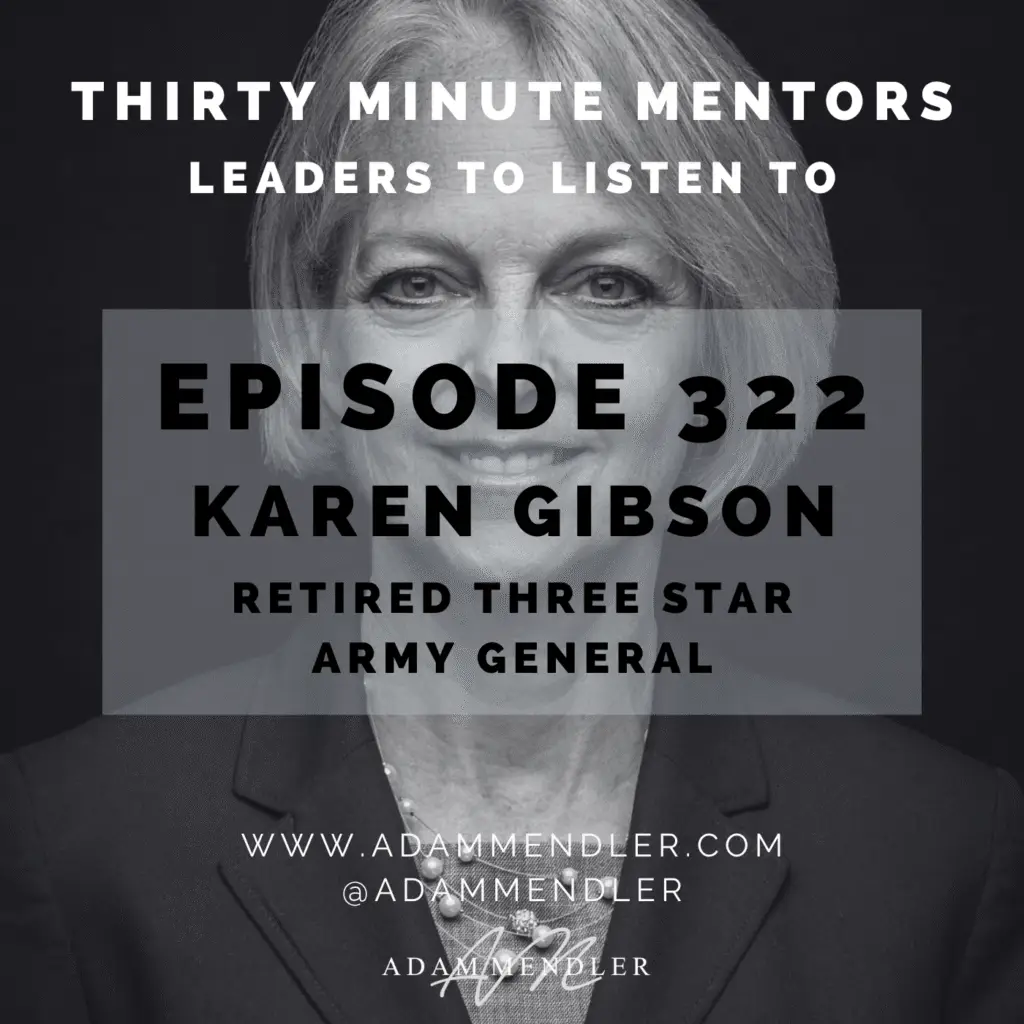
Lieutenant General Karen Gibson is one of the highest-ranking women in the history of the United States Army and served as the Sergeant at Arms of the United States Senate upon retiring from the Army. LTG Gibson joins Adam to share her journey and her best lessons and advice. LTG Gibson and Adam discuss a wide range of topics: career success, inspirational leadership, crisis leadership, leadership development, managing change, and much more.
Join Adam and the best network of mentors – Fortune 500 CEOs, founders of household name companies, Hall of Fame and Olympic gold medal-winning athletes, political and military leaders – for intimate half-hour conversations each week.
Thirty Minute Mentors is available wherever you listen to podcasts. If you enjoy the episode, visit your favorite podcasting app and subscribe, rate, and leave a review, and spread the word by sharing on your social media channels and sharing directly with your friends and colleagues.
Read the full transcript of Adam’s conversation with General Gibson.
Episode Summary
Lieutenant General Karen Gibson is one of the highest-ranking women in the history of the United States Army. She served as Deputy Director of National Intelligence for National Security Partnerships, Director of Intelligence for U.S. Central Command, and Sergeant at Arms of the United States Senate. In this episode of the Thirty Minute Mentors podcast, she shares the leadership lessons she learned over a 33-year Army career and in the Senate.
General Gibson describes growing up in Bozeman, Montana, where chores, grit, and a refusal to let weather change the plans shaped her. Her first duty station was in Alaska with the Sixth Infantry Division, including an exercise in which temperatures hit 50 below. The lesson she took away is that leaders rarely get to pick their operating conditions, so they must assess the environment, build a plan that works in it, and keep going rather than saying it is too hard.
She explains how to build a culture of agility, starting with commander’s intent, the practice of telling people not just what to do but why, so teams can adapt when circumstances change. She warns that micromanagers stifle initiative and encourages leaders to forgive mistakes and review them in an after-action report. She also outlines four ways to grow as a leader: reading, mentors, self-reflection, and observing the leaders around you, including the ones whose habits you never want to copy.
General Gibson contrasts a battalion commander who led by yelling with Major Ron Burgess, who calmly explained how embarrassing her failed arms room inspection was and laid out how she would fix it. She says leaders inspire through competence and mutual respect, not fear. On leading in crisis, she highlights taking care of people physically and preparing for the emotional aftermath, which she saw when she took over a demoralized Senate staff and banned talk of failure.
She compares the Senate, where she says she worked for 135 small businesses, with the military, and tells women in male-dominated environments to let competence and excellence speak. She closes with advice to know your strengths and gaps and to seek experiences that stretch you.
What You’ll Learn
- Why General Gibson says leaders do not get to pick the conditions of their operating environment, and how a 50-below exercise in Alaska taught her to plan and keep going.
- How commander’s intent, explaining what you hope to accomplish and why, lets teams adapt when circumstances change, and why micromanagers stifle initiative over time.
- Why General Gibson encourages leaders to forgive mistakes and talk through them in an after-action review unless something is immoral, illegal, unethical, or grossly unsafe.
- What a calm major who explained how embarrassing her failed arms room inspection was taught her about leading through respect, compared with a commander who led by yelling.
- Which two crisis imperatives people often overlook: taking care of people physically with sleep and food, and preparing for the emotional aftermath once the crisis passes.
- How being the only woman and youngest officer in a winter warfare course, and finishing near the top of its combat biathlon, taught her that competence earns respect.
About Lieutenant General Karen Gibson
Lieutenant General Karen Gibson is one of the highest-ranking women in the history of the United States Army. She grew up in Bozeman, Montana, attended Purdue, and joined the Army through ROTC. Over 33 years in uniform, she served as Director of Intelligence for the Combined Joint Task Force, Deputy Commanding General for U.S. Army Cyber Command, Director of Intelligence for U.S. Central Command, and Deputy Director of National Intelligence for National Security Partnerships. After retiring, she became the Sergeant at Arms of the United States Senate.
Related Episodes
- Episode 335: Lieutenant General Jody Daniels
General Daniels pushed signature authority down as far as regulation allowed, writing a memo for each policy, and says doing so saved her time later. - Episode 340: General Gary Brito
General Brito describes a master sergeant telling him as a second lieutenant to take care of his troops and not his evaluation, a guidepost that became his true north. - Episode 337: Headspace CEO Tom Pickett
Tom describes leading a package of 20 to 25 airplanes over Iraq as a Navy fighter pilot at 27, and says the military gives people management responsibility far earlier than business does. - Episode 327: Senator Max Baucus
Senator Baucus describes building health care reform from the bottom up in the Senate Finance Committee over about 15 months, with three rules: no politics, everything on the table, and bring a solution with every problem. - Episode 332: LPL Financial CEO Rich Steinmeier
Rich describes pushing decision-making as low as possible, starting with a shared five-year vision and working backward to milestones so he does not have to micromanage.