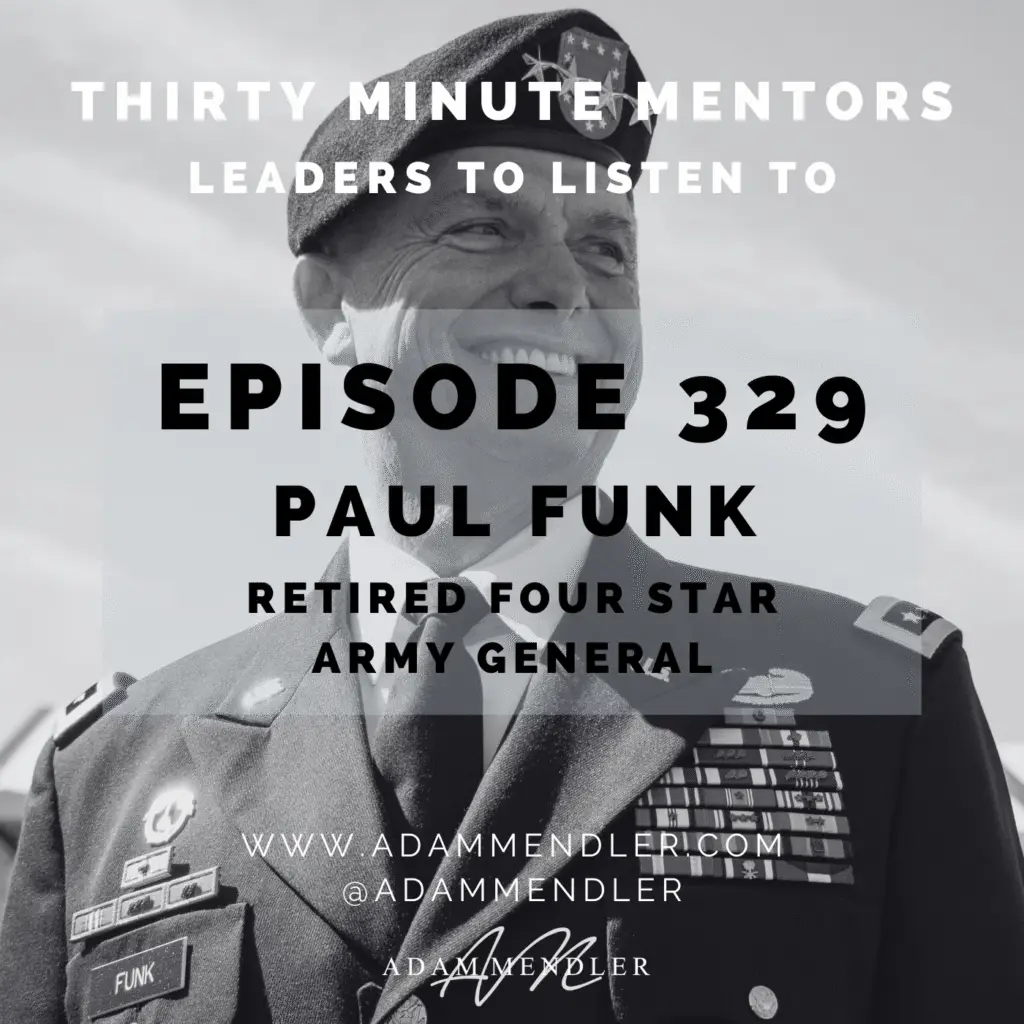
General Paul Funk is a retired four-star general who led the world’s largest international coalition against ISIS in Iraq and Syria and served as the commanding officer of the Army Training and Doctrine Command, responsible for overseeing the training of Army forces. General Funk joins Adam to share his journey and his best lessons and advice. General Funk and Adam discuss a wide range of topics: leadership, teamwork, training and development, coalition building, mentorship, purpose, and much more.
Join Adam and the best network of mentors – Fortune 500 CEOs, founders of household name companies, Hall of Fame and Olympic gold medal-winning athletes, political and military leaders – for intimate half-hour conversations each week.
Thirty Minute Mentors is available wherever you listen to podcasts. If you enjoy the episode, visit your favorite podcasting app and subscribe, rate, and leave a review, and spread the word by sharing on your social media channels and sharing directly with your friends and colleagues.
Read the full transcript of Adam’s conversation with General Funk.
Episode Summary
General Funk grew up an Army brat on bases including Fort Hood, the son of a three-star general. He planned to stay in the Army for three years, but he loved team sports and came to see the military as the greatest team ever assembled. A great team, he says, listens, develops its own shorthand, and presses each other for excellence. He draws on James Kerr’s book Legacy, about the New Zealand All Blacks, and its idea that you are just the body in the jersey and are responsible for leaving it in a better place. That line is the last of Funk’s Fundamentals, the 40 principles he collected over 42 years of service.
On rising in a career, General Funk lists hard work, sacrifice, lifelong learning, some luck in who you work for, and mentorship. He distinguishes mentorship, which improves your current performance, from sponsorship, which recognizes potential and speaks your name in rooms you are not in. Marty Dempsey, whom he met in Desert Storm and who became a lifelong friend, was willing to sponsor him in rooms he was not in. His practical advice is to do the boss’s work first, because then you have time for your own goals.
For General Funk, the essence of leadership is understanding people, because people do not care how much you know until they know how much you care. He says trust takes years to build and can be lost in a moment, and he recalls his father’s saying from Desert Storm, when he was Funk’s division commander: talking ain’t fighting. A leader’s most finite resource is time, so how you spend it preparing your organization matters most.
General Funk led the 72-nation coalition against ISIS in Iraq and Syria, and he says the key was understanding the strengths and weaknesses of each partner. Nations joined with caveats, such as fighting in Iraq but not Syria, and a leader has to know which caveats help and which not to push. He sometimes used another nation’s looser information restrictions and put a message out through its media as a proxy.
Today General Funk is working with Larry Smith, former chairman of Tokyo Electron US, on a military talent pipeline in central Texas that prepares veterans for high-paying jobs. He asks soldiers why they joined and why they stay, and says the answer to the second question is almost always people. He tells of a young nurse who had been living in her car when an Army recruiter found her, and who later built a walking blood bank that collected 27 liters of blood in about an hour. He says he never had a bad day in the Army.
What You’ll Learn
- Desert Storm showed what overwhelming combat power can do, General Funk says, as the third largest army in the world became the second largest in Iraq in about 100 hours.
- Onboarding is the one place you have everyone’s attention, General Funk says, so leaders should explain their vision to new employees, even for one hour a month, which he says will save man-years.
- People learn through significant emotional experience and repetition, General Funk says, which is why the Army builds training around tasks, conditions, and standards that prepare soldiers for every mission essential task.
- Every time you think you’re somebody important, General Funk says, try ordering around somebody else’s dog, because behaviors matter and you cannot fake how you live your life.
- Simplicity is the most important and most overlooked principle of war, General Funk says, because it lets a sergeant and squad execute complex tasks when they understand what the boss several levels up wants.
- When people thank him for his service, General Funk answers “you’re worth it,” a reply he borrowed from Medal of Honor recipient David Bellavia.
About General Paul Funk
General Paul Funk is a retired four-star Army general who served 42 years and led the world’s largest international coalition against ISIS, a 72-nation effort in Iraq and Syria. His commands included the Army Training and Doctrine Command, which oversees the training of Army forces, as well as Fort Riley and Fort Hood, the base where he grew up. He compiled Funk’s Fundamentals, a list of 40 principles from his career, and is now focused on upskilling and a military talent pipeline in central Texas to help veterans move into high-paying jobs.
Related Episodes
- Episode 340: General Gary Brito
General Brito describes a master sergeant telling him as a second lieutenant to take care of his troops and not his evaluation, a guidepost that became his true north. - Episode 335: Lieutenant General Jody Daniels
General Daniels describes learning early to train your replacement, and how a sergeant she respected would pull her aside to tell her she was about to muck something up. - Episode 337: Headspace CEO Tom Pickett
Tom describes leading a package of 20 to 25 airplanes over Iraq as a Navy fighter pilot at 27, and says the military gives people management responsibility far earlier than business does. - Episode 330: Priceline Co-Founder Paul Breitenbach
Paul says coachability is one of the most important traits for a leader, starting with the self-awareness to know your strengths and weaknesses and the discernment to be careful who you ask. - Episode 332: LPL Financial CEO Rich Steinmeier
Rich describes sharing LPL’s five-by-five playbook with every employee so they can see how their role contributes to where the firm is headed and make decisions accordingly.